

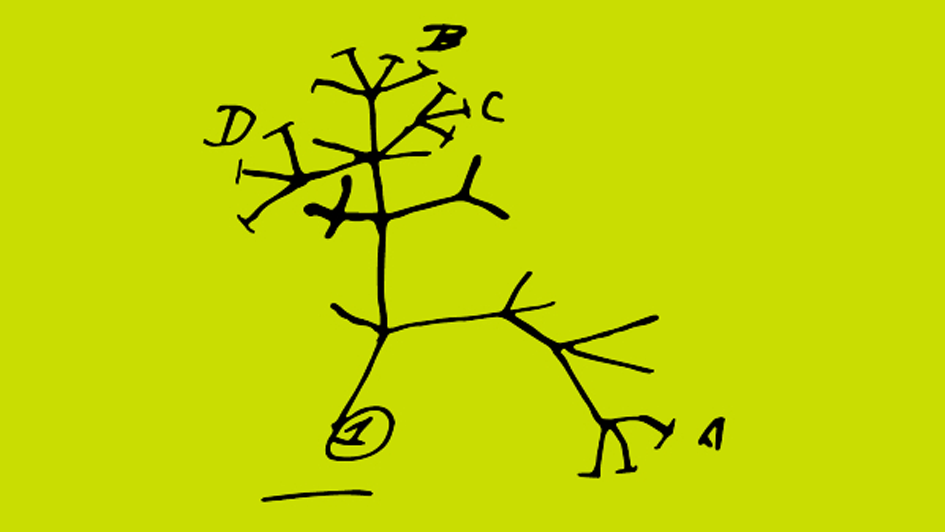
Image: Charles Darwin's Tree of Life
The 12th of February 2021 marks Sir Charles Darwin’s 212th birthday – a day when biologists and many others remember one of the greatest scientists to have ever lived, whose work and theories transformed biology and the world.
Sir Charles Darwin’s observations that species adapt through variations passed on from one generation to the next is the basis of modern biology – a deceptively simple rule that accounts for all of the variation we see in the natural world.
All organisms, big and small, evolve over time to adapt to the environments they inhabit – and the same is true for cancer. Understanding evolution is key to the study of cancer and to developing new treatments for the disease. It’s also pretty important when it comes to fighting viruses like Covid-19.
This Darwin Day, we spoke to two of our researchers working in the ICR’s Centre for Evolution and Cancer, who are building on Darwin’s theories of evolution to explore new ways to treat cancer.
The ICR's Centre for Evolution and Cancer aims to apply Charles Darwin’s principle of natural selection to our understanding of why we develop cancer and why it is so difficult to treat.
‘Non-genetic’ evolution that could cause resistance in childhood cancer
 Dr Alejandra Bruna is leader of the Preclinical Modelling of Paediatric Cancer Evolution Team, and she is trying to find the evolutionary components that drive cancer in children.
The ICR is an internationally leading research centre in the study of cancer in children, and Dr Bruna’s work focuses on neuroblastoma, the most commonly fatal solid tumour in children, among other solid paediatric cancers.
One of the main features of cancer is genomic instability, with most adult cancers displaying high levels of mutations which cancer is able to exploit for survival.
Following Darwin’s theories of Natural Selection, each mutation could potentially help a cancer cell adapt to its environment better to survive, with beneficial adaptations being passed on through cell division.
Preventing or targeting mutations is an important way to treat cancer, but childhood cancers often display very few mutations, and researchers like Dr Bruna think that there may be different evolutionary forces at work.
Her research is looking at epigenetic changes in childhood cancer cells – changes to genes that aren’t caused by mutations, but that can turn genes on and off in cells.
Her team are investigating whether these epigenetic changes could be the driver for how neuroblastoma cells evolve, which could explain how cancer cells with very few mutations can adapt and develop resistance to treatments.
Dr Bruna says, “If non-genetic evolution plays a role in resistance to therapy in paediatric tumours, then we should be trying to focus on finding treatments that target these non-genetic events.”
She is using a technique to barcode cells in samples of neuroblastoma, to trace cell dynamics and epigenetic changes over time, which may identify the triggers for mutations that lead to resistance to treatment.
Finding the epigenetic changes that lead to resistance in neuroblastoma will be a challenge, but if they can show that they happen before mutations occur, this incredibly exciting discovery could open up new avenues for treatment for childhood cancers.
Modelling prostate cancer evolution, from patient to patient
The ICR’s Centre for Evolution and Cancer has developed sophisticated computer simulations to model how tumours evolve over time, but recreating the complexity of the disease seen in humans is still a huge challenge.
Diseases like prostate cancer are caused by hundreds of mutations that build up in cancer cells, so to understand how prostate cancer might evolve in patients, tests that help reflect this diversity are needed.
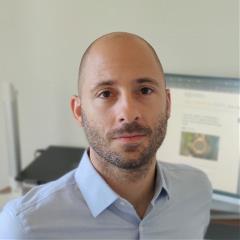 Dr Marco Bezzi leads the Tumour Functional Heterogeneity Team at the ICR, and he is using lab-grown mini-tumours called tumour organoids that more closely resemble cancer as its seen in the clinic, to better understand how prostate cancer evolves.
Dr Bezzi says, “The ICR’s mathematical modelling is really strong, and you can really follow how tumours develop through evolutionary principles. My research takes a very ‘wet lab’ approach to complement this, by recreating the heterogeneity and selective pressures that cancer faces. We can then track this experimentally to understand how tumours evolve.”
His lab generates biobanks of cancer organoids they use to mix together different mutations and grow tumour organoids with distinct genetic patterns.
These organoids can have several different mutations important to prostate cancer within one tumour, which can be studied in mice to see how these populations evolve.
Like Dr Bruna’s team, they hope to track how tumours evolve across generations of cancer cells using barcodes, to see which mutations give cells survival advantages and are passed on, and which die out.
Working together with mathematical modelling, ICR scientists can test how simulations of cancer evolution stand up to real-world examples to refine their predictions.
The goal is to use these different tools in the lab to understand how tumours in patients may evolve in response to treatment, so they can suggest new treatments as tumours adapt and help patients survive for longer.
These two examples take very different approaches to cancer evolution, but they show how this fundamental principle of life can be harnessed to learn more about cancer and design better ways to treat the disease.
Working together for a common cause
.jpg "CCDD_sunset_945x532(1)")
Image: The ICR's Centre for Cancer Drug Discovery
Dr Bruna and Dr Bezzi have just moved into the ICR’s new Centre for Cancer Drug Discovery, where researchers working in cancer evolution benefit from the expertise of their colleagues discovering new cancer drugs.
The building is the first of its kind to host hundreds of scientists from different disciplines under one roof to lead an unprecedented 'Darwinian' drug discovery programme that aims to overcome cancer’s ability to evolve resistance to drugs and ‘herd’ it into more treatable forms.
The ultimate aim is to transform cancer into a manageable disease that can be controlled long term and effectively cured.
Dr Bezzi says, “As a biotechnologist most of what I do is genetic engineering, so it’s fantastic to have access to the expertise of my colleagues in drug discovery.
“By sharing the same spaces, we can share our expertise and knowledge. I can have those quick conversations about experiments and ask them what might be the best drug for a specific type of disease or for that specific patient. The connection we have to the clinic is amazing and it ensures that my work is studying the right questions to help patients.”
In our pioneering Centre for Cancer Drug Discovery, our researchers are now developing a new generation of drugs that will make the difference to the lives of millions of people with cancer.
But we still need your support to help finish equipping the Centre and to continue to fund the exciting work that is now taking place within the building.
What cancer can teach us about Covid-19?
As the world battles with the coronavirus pandemic, scientists can apply the same evolutionary thinking our researchers use in cancer to overcome Covid-19.
Professor Andrea Sottoriva, Director of the Centre for Evolution and Cancer in the Centre for Cancer Drug Discovery, says: “Evolutionary biology is one of the most important theories of biology, in the same way that we have general relativity in physics. The theory of evolution allows us to make sense of the observations we see in biology and medicine more widely, and this is also true for the pandemic.”
“We understand how viruses evolve through the lens of evolutionary biology and we design new vaccines that combat the evolution of viruses to adapt and survive, like what we regularly see in the flu.”
The variants we are now seeing in Covid-19 are evidence of the fundamental mechanisms that drive how all organisms evolve, including cancer.
Not every variation provides a survival advantage to viruses, making viruses more contagious or more resilient, and viruses often need a number of significant changes before vaccines will no longer work, but by studying how they change and evolve, doctors can attempt to get ahead of new variants with improved vaccines, helping curb transmission and save lives.
Dr Bruna said: “Just like cancer, viruses are made of genetic material, and so they will evolve adaptations that are beneficial to the virus. But scientists will be expecting this and they are monitoring variations in the virus that are occurring.”
With cancer the rules are exactly the same, and our researchers are coming up with new ways to model the disease's evolution and to find the triggers that help cancer develop.
And so, despite the death of Sir Charles Darwin more than 130 years ago, the impact of his work lives on and acts as inspiration for researchers around the world, and will continue to do so for generations to come.