
Help give everyone with bowel cancer the hope of a cure
“I prepared for my kids to grow up without me. Thanks to research, I am now cancer-free”
Sophie Umhofer (pictured above), a mother of two, was diagnosed with stage four bowel cancer in 2018, aged 36. She was told she would be unlikely to see her 40th birthday. Sophie joined an experimental immunotherapy trial, specifically for patients whose cancers have a faulty BRAF gene, and, after two years, was told there was no sign of cancer in her body.
We urgently need to find new ways to prevent, diagnose and treat this disease. With your support, we can drive forward bold new research, to save more lives.
Donate monthlyWhat is bowel cancer?
Bowel cancer, often called colorectal cancer, is a type of cancer that begins in the large bowel, which includes the colon and the rectum.
Thanks to screening programmes, earlier diagnosis and advances in treatment, survival has improved dramatically in recent decades. Our world-class scientists are pushing the boundaries of research to defeat bowel cancer, but it still remains the second biggest cancer killer in the UK.
Why do we need more research into bowel cancer?
A worrying trend is emerging, as bowel cancer rates in people under the age of 50 are rising sharply – and are expected to double again between 2010 and 2030. These cancers in younger adults are often more aggressive and diagnosed later, leading to poorer outcomes.
Our scientists are tackling the rise in cases among young adults and improving early detection in people at increased risk – so that we can prevent these cancers from growing in the first place. Together, this research is shaping a future in which bowel cancer is more preventable, predictable and treatable.
Caroline's story
Caroline’s only child, Bradley, was diagnosed with advanced bowel cancer aged 22 and died 14 months later. This year marks the fifth anniversary of Bradley’s death.
"I support research into why rates of early-onset bowel cancer are rising. I don't want any other young person, or parent, to endure what we went through."
Mo's story
Shortly before his 32nd birthday, Mo Haque was diagnosed with stage four inoperable bowel cancer. He was told there was only a small chance he could be treated successfully.
Following his diagnosis, Mo also learned he had Lynch syndrome, a genetic condition which makes him more pre-disposed to certain types of cancer. Mo started immunotherapy in 2016, which was successful. Since 2018, there has been no evidence of disease in his body.
"Cancer research has been absolutely crucial in keeping me alive."
Our bowel cancer research
Tackling cancer evolution
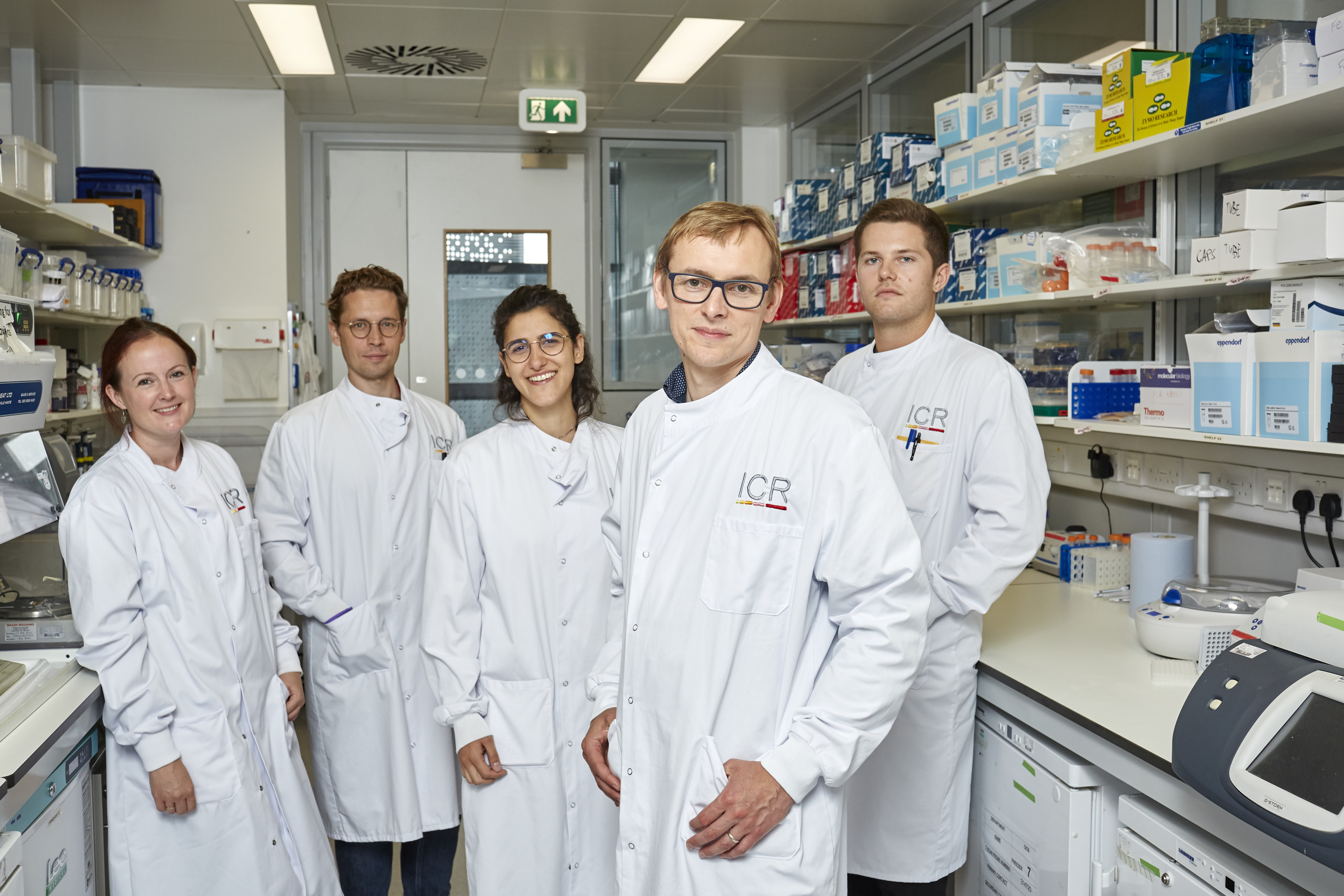
Our researchers are at the forefront of understanding how bowel cancer develops and evolves resistance to treatment – and finding ways to stop it.Professor Trevor Graham combines evolutionary science, computational biology and cutting-edge laboratory techniques to understand how bowel cancer evolves as it grows, spreads and responds to treatment.
Professor Graham’s team has recently pinpointed bowel cancer’s ‘Big Bang’ moment – the point at which cancer cells first evade the immune system through DNA changes that make tumours harder to spot. This exciting discovery could help researchers develop new, more effective treatments that can stop the disease in its tracks. It could also help doctors identify which patients are more likely to benefit from immunotherapy treatments.
Research led by Professor Anguraj Sadanandam has shown that the immune system plays a critical role in radiotherapy’s success. By studying tumour samples from 53 patients, his team discovered that inflammation levels before and after treatment influence outcomes. These insights have helped shape new strategies, such as adding immunotherapy to radiotherapy.
Bold new ideas to defeat bowel cancer
By predicting risk and determining why cases are rising among younger adults, our scientists are finding new ways to prevent and treat bowel cancer more effectively.
Professor Clare Turnbull has helped to establish a national database to track people with Lynch syndrome – a hereditary condition that raises the lifetime risk of bowel cancer to up to 80 per cent. By ensuring that everyone with Lynch syndrome is invited for regular screening, the registry aims to detect cancers earlier, when treatment is most likely to be successful.
Together, we can keep pushing the boundaries of research
Our research is giving everyone with bowel cancer the hope of a cure and, potentially, preventing the disease from developing in the first place.
Give a regular gift today to help us make more discoveries and save more lives.
Related news and blogs
Targeted therapy shows promise for patients with advanced colorectal cancer in a first-in-human study

Excess weight is the strongest clue to the rise in cancer rates in under 50s
Scientists develop new way to determine which patients will respond best to bowel cancer treatment