Opportunities for clinicians
At The Institute of Cancer Research, London, we offer clinicians a variety of opportunities – from a taught master's course in Oncology, to fellowships providing protected time for research, and higher research degrees.
Clinicians make up one-third of research team leaders at the ICR. This essential link between basic scientific research and clinical practice helps to get treatments into patients sooner, while ensuring that clinical knowledge is fed back to researchers, who can then develop more effective treatments.
MSc in Oncology
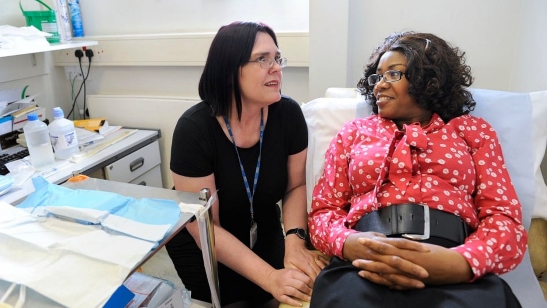
Our MSc in Oncology is a taught master's degree run as a day release course for medically qualified candidates who intend to pursue a career in clinical or medical oncology. The overall aim is to encourage proactive problem solving approaches and a reflective approach to medical or clinical oncology practice, producing graduates who are well equipped for leadership careers in twenty-first century oncology.
Find out more about MSc in Oncology
Clinical Academic Training Pathway
For those wishing to follow a clinical academic training path the following opportunities are listed in the order they would be undertaken.
NIHR Academic Clinical Fellowships
The ICR and The Royal Marsden NHS Foundation Trust have a number of Academic Clinical Fellowships available as part of the National Institute for Health and Care Research (NIHR) Integrated Academic Training Programme. These are three-year posts for clinicians in the early stages of specialty training and provide trainees with 25 per cent protected time for research training.
Find out more about NIHR Academic Clinical Fellowships
PhD and MD(Res) for clinicians
There are two options available for clinicians who wish to pursue higher research degrees:
Doctor of Philosophy - PhD
The ICR offers PhD programmes to applicants eligible for full registration or who hold limited registration with the General Medical Council. These three-year fellowships are intended to develop the applicant’s potential to pursue a career as an academic clinician.
Doctor of Medicine (Research) - MD(Res)
The MD(Res) is a research programme specifically designed for clinically-qualified trainees, lasting a minimum of two years (or part-time equivalent). These provide clinical specialists the opportunity to work in a unique multidisciplinary environment alongside world leaders in cancer research and clinicians from The Royal Marsden NHS Foundation Trust.
Find out more about PhD and MD(Res) for clinicians
NIHR Clinical Lectureships
NIHR Clinical Lectureships are aimed at those who are advanced in their specialty training, have completed a research degree and show outstanding potential for continuing a career in academic medicine. Clinical Lectureships allow clinical researchers to spend half of their time undertaking specialist clinical training and half undertaking research training.
Opportunities for Postdoctoral Clinical fellows
The Emerging Clinical Academic Fellowship scheme, newly launched by CRIS Cancer Foundation and the ICR, offers 2-3 year fellowships to support the development of early postdoctoral-stage clinical researchers.
The programme will help to prepare outstanding clinical researchers to apply for group leader positions – either as a clinician scientist or career development faculty.
Latest ICR News

New trial design could improve early-stage cancer studies involving CAR-T therapies

Researchers develop gene-editing platform to systematically decode histone function in mammalian cells

New clinical trial design could improve dose selection, maximising treatment efficacy and safety