
Centre for In Vivo Modelling Service Core

At the Centre for In Vivo Modelling (CIVM), we combine advanced animal genetics and cutting-edge technologies to drive cancer research. Our multidisciplinary team specialises in the generation and maintenance of genetically engineered mouse models (GEMMs), humanised mouse strains, and patient-derived models (xenografts and organoids), using innovations such as CRISPR gene editing, embryo manipulation, and in vivo genetic screening. We develop and cryopreserve new cancer models that closely replicate human disease, supporting translational studies that inform effective therapies. Our approach integrates rigorous scientific standards, ethical oversight, and collaborative expertise, aiming to accelerate progress in understanding cancer biology and developing better treatments for patients.

Our Centre is dedicated to driving innovation and excellence in cancer research through advanced in vivo modelling. We work in close collaboration with the ICR researchers and clinicians at The Royal Marsden to generate genetically engineered mouse models (GEMMs) and patient-derived models, such as patient-derived xenografts (PDXs) and patient-derived organoids (PDOs) to interrogate cancer biology in its own ecosystem. By leveraging these sophisticated in vivo systems, the Centre aims to:

  • Develop innovative cancer models in collaboration with ICR researchers to advance cancer research and drug discovery.
  • Work in partnership with The Royal Marsden Hospital to obtain patient samples and generate new patient-derived cancer models for translational studies.
  • Foster close interdisciplinary collaboration with drug discovery teams to leverage these in vivo models in the creation and testing of next-generation anti-cancer therapies.
  • Continuously improve the sophistication and relevance of our cancer models, ensuring they more faithfully recapitulate the complexity of human disease and enhance the translational impact of our research.


Our services

Advantages of cryopreserving your strains:

  • Allows you to save space, by getting the mice you need, when you need;
  • Reduces your animal costs;
  • Reduces animal use;
  • Reduces risk from disasters (e.g. disease outbreaks, breeding cessation, equipment failures, genetic contamination, natural disasters, etc…).

 What can be cryopreserved?

  • Mouse Sperm
  • Mouse Embryos
  • Mouse Embryonic Stem Cells
  • Mouse Oocytes

 Sperm Cryopreservation:

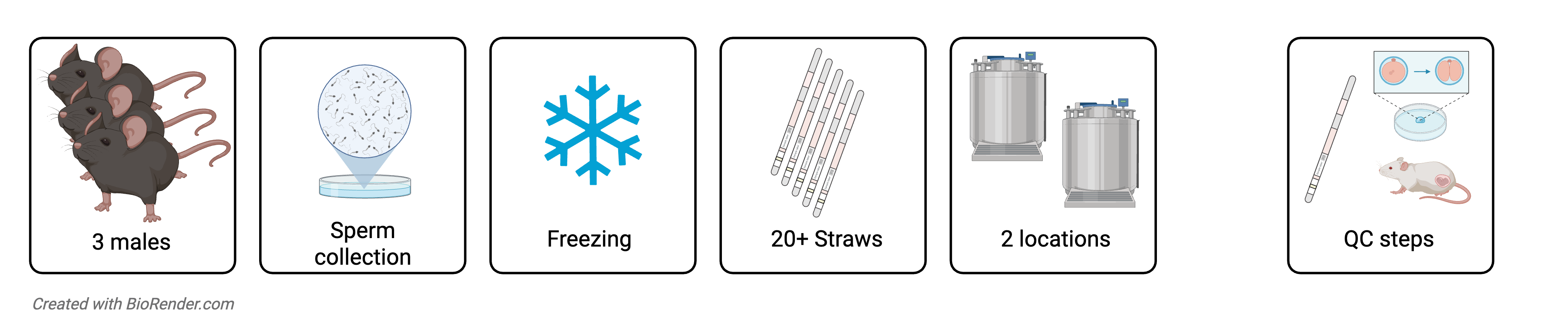
Description: Sperm is retrieved from the epididymal tissues of 3 male mice and is cryopreserved in 20 to 30 straws that are stored in liquid-phase, liquid nitrogen across two tanks in two separate locations (SRD and CCDD), to ensure sample safety and mitigate risks associated to unexpected or uncontrollable events.

Material needed: 3 males, reproductively active, 12-25 weeks old

Timeline: 2-6 weeks (dependant on QC method of choice)

Considerations: this method of cryopreservation is rapid and cheap; however, it only preserves half of the genome. This method is only recommended for single mutations on a common inbred background.

Quality Control: we provide different levels of Quality Control (QC) for different price ranges.

  1. Test thaw QC: we will thaw 1 straw the day after cryopreservation and visually assess motility and viability of the recovered sperm
  2. IVF and culture to blastocyst QC: we highly recommend this QC step. In addition to test thaw, we will also perform IVF and culture embryos up to blastocyst stage. We will provide the investigator with a fertility rate (%) for the recovered sperm. We will charge an extra cost to cover the IVF procedure.
  3. IVF and embryo transfer QC: In addition to test thaw, we will perform IVF and transfer 2-cell embryos into up to 3 pseudopregnant females to generate viable embryos/live pups. We will charge an extra cost to cover the IVF and embryo transfer procedures.

    Please note that we require you to provide your genotyping protocol, as well as full detail of the genetic content of each strain that you submit for cryopreservation.

Diagram of Sperm Cryopreservation

Embryo Cryopreservation:

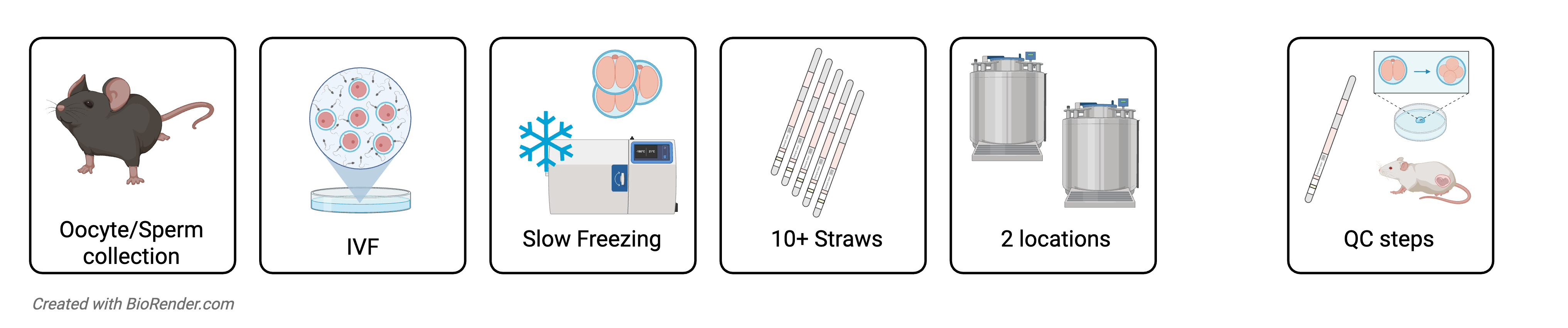
Description: Female mice are hormonally superovulated and oocytes are retrieved for in vitro fertilisation (IVF) with sperm from donor male. Resulting embryos are placed in cryoprotectant and loaded into multiple straws, which are gradually cooled and stored in liquid-phase liquid nitrogen in two separate tanks.

Material needed: Donor male and 8-10 donor females

Timeline: 12-15 weeks

Diagram of Embryo Cryopreservation

Embryonic Stem Cells Cryopreservation:

Not available, yet.

Oocyte Cryopreservation:

Not available, yet.

Cryostorage:

If you have cryopreserved mouse sperm/embryo/oocytes at another institution, we can cryostorage your samples for an annual fee. We do require that the investigator takes charge of shipping costs into our facility, and that thawing and genotyping protocols are submitted to the CIVM.

The CIVM stores all samples in liquid-phase liquid nitrogen tanks (CryoPlus1, ThermoFisher Scientific). Material retrieved from each strain is split between 2 tanks, a main and a backup tank, for redundancy. For additional safety, these 2 tanks are located in two separate buildings at ICR Sutton. Both tanks are continuously monitored by T-scan alarm systems and undergo annual service, as well as daily visual inspections.


Sperm Cryorecovery:

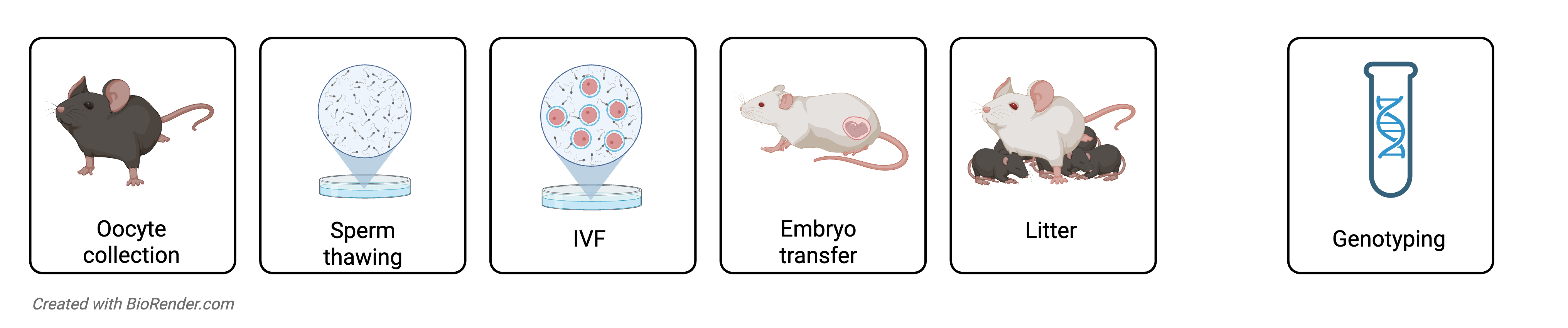
Description: Frozen sperm is cryorecovered by IVF, followed by embryo transfer. We can purchase wild-type female oocyte donors of the same genetic background, or alternatively the investigator can provide homozygous oocyte donors of the same strain.

Material needed: straw with frozen sperm and 8 to 12 females for IVF, 7-16 weeks old.

Timeline: 12-15 weeks

Diagram of Sperm Cryorecovery


Embryo Cryorecovery:

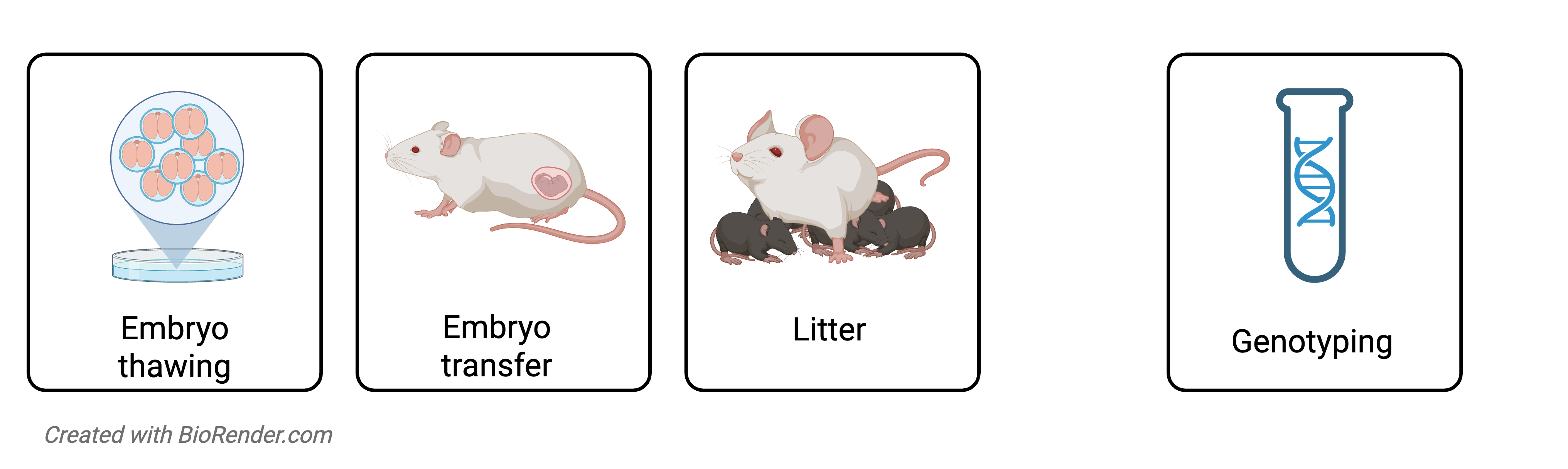
Description: Frozen 2-cell embryos are thawed and transferred into pseudopregnant females.

Material needed: straw(s) with frozen 2-cell embryos

Timeline: 8-10 week


Oocyte Cryorecovery:

Not available, yet.


Mouse rederivation

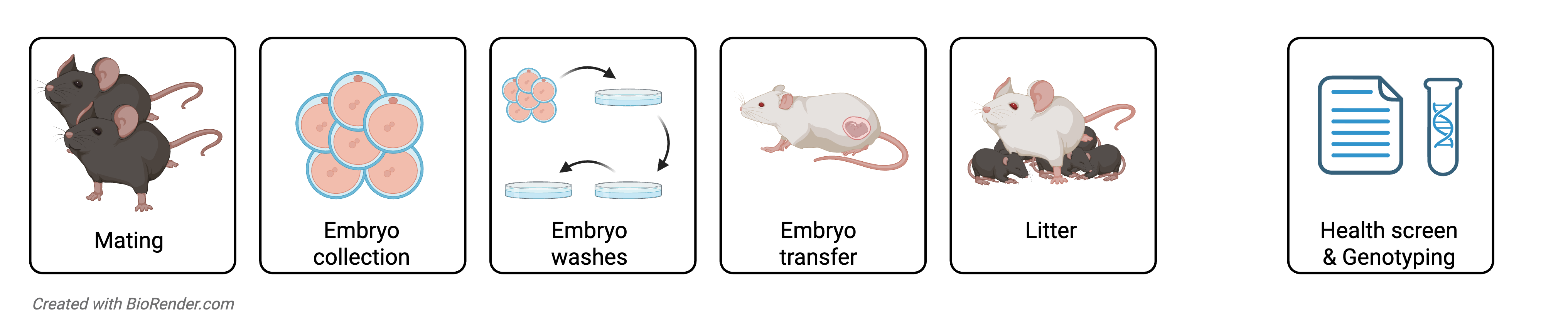
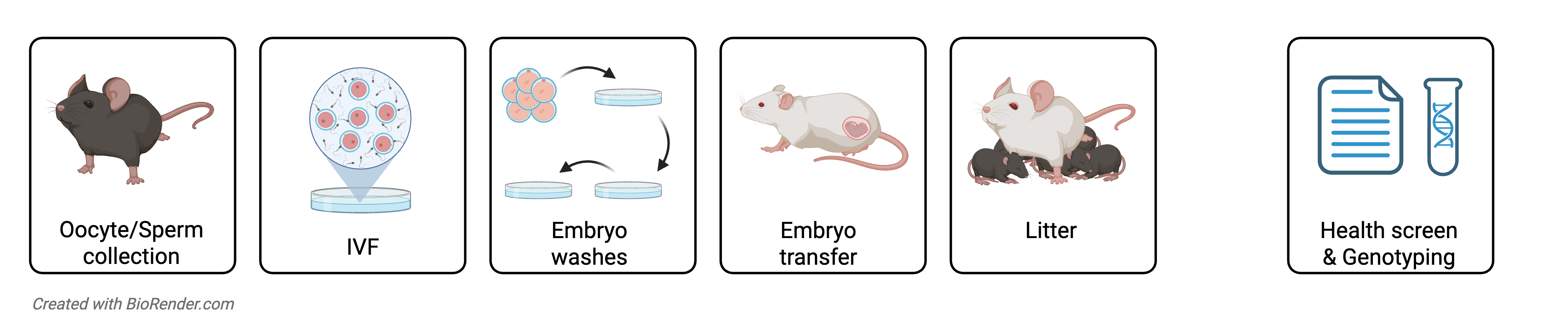
Description: Mouse rederivation is a process used to produce pathogen-free mouse colonies by removing microbial contaminants from existing lines. The procedure can be performed either through natural mating or in vitro fertilization (IVF):

  • In natural mating, embryos are obtained from donor mice and transferred into pathogen-free recipient females.
  • In IVF-based rederivation, fertilized embryos are created in vitro using gametes from donor mice and then implanted into clean recipient females.

Both methods effectively eliminate pathogens, allowing safe importation of mouse strains from lower health-status facilities into the ICR BSU. Samples from both litter and recipient mother will be sent for Health Screening and the associated costs will be charged separately to the Investigator.

Material needed: For IVF-based rederivation we require the investigator to provide 2 males, reproductively active, 12-25 weeks old, and the CIVM will purchase wild-type female egg-donors. Alternatively, if maintaining homozygosity is essential, the investigator will need to provide additional 6-10 females, 7-16 weeks old.

Timeline: 12-15 week

Mouse Rederivation Mating Diagram

Mouse Rederivation IVF diagram

We are currently setting up CRISPR/Cas9-based gene editing protocols. Soon, you’ll be able to apply for projects that involve developing new alleles based on:

  • Knockout by indel formation
  • Knockout by precise deletion
  • Conditional knockout
  • Knock-in of point mutations
  • Knock-in of small tags
  • Large knock-in
  • Exon replacement

These alleles will be developed based on Electroporation of Microinjection of CRISPR/Cas9 system reagents.

We will collaborate with you to design the best strategy and help you generate the genetically engineered mice you need for your project. 

We also provide:

  • Development of humanised mouse strains
  • Development of Patient-derived xenografts (PDX) and organoid models

Latest ICR News

07/01/26

Tens of thousands of tumour samples which have been stored in the basement of a London hospital for more than 70 years could be the key to unlocking the mystery of why bowel cancer cases are rising in the under 50s, scientists believe.

Researchers at The Institute of Cancer Research, London, and St Marks Hospital are launching a pioneering study to compare bowel cancer specimens from the 1960s with modern-day cancer samples.

Using cutting-edge lab techniques, the team hopes to uncover how changes in diet, lifestyle, and environmental exposures – collectively known as the exposome – may be driving the rise in cases of early-onset bowel cancer.

Bowel cancer is the fourth most common cancer in the UK and the second leading cause of cancer deaths. While screening programmes have helped reduce cases in older adults, diagnoses among younger people have been climbing in recent years –and are expected to double between 2010 and 2030.

Early-onset cancers are found later 

Some studies have shown that these early-onset cancers are diagnosed at a later stage and seem to behave more aggressively than bowel cancer in older people, so even with better treatments, the outcomes for these patients are often poor.

Research has so far been unable to determine why bowel cancer is becoming more common in younger people, although many theories have been proposed, including changes in diet and lifestyle, exposure to environmental pollutants such as microplastics, and even changes to the bugs living in the bowel (known as the microbiome).

The study, called the “Boomers Project”, will use preserved pathology specimens from St Mark’s Hospital, home to one of the UK’s oldest archives of bowel cancer samples. Early tests have shown that even after decades in storage, the samples, some of which date as far back as the turn of the 20th century remain intact and suitable for advanced molecular analysis techniques.

Mapping how DNA is altered in old samples

Different environmental exposures – such as smoking or diet – each shape the DNA inside the cancer in unique ways. The researchers plan to use genome sequencing techniques – including novel approaches developed at The Institute of Cancer Research (ICR) – to map how the DNA is altered in the cancer specimens from the 1950s compared to cases from the present day. The comparison will show how environment exposures have changed over the past decades.

If successful, the project could pave the way for a larger-scale investigation and inform new strategies for prevention, diagnosis, and treatment.

Professor Trevor Graham, Professor of Genomics and Evolution and Director of the Centre for Evolution and Cancer at The Institute of Cancer Research, London, said:

“People in the 1960s lived differently to people today. We believe that the exposome – the changes in diet, lifestyle and environmental factors we are exposed to – is contributing to the increase in cases and deaths from bowel cancers in younger adults.

'We hope to identify exactly what is driving the increase in bowel cancer diagnoses in younger adults'

“By performing detailed molecular analysis of bowel cancers from the 1960s and comparing the results to bowel cancers from today, we hope to identify exactly what is driving the increase in bowel cancer diagnoses in younger adults. This could lead to new strategies for bowel cancer prevention and treatment.” 

Project co-lead Professor Kevin Monahan, Gastroenterologist and Co-Director of The St Mark’s Centre for Familial Intestinal Cancer, said:

 “We have a lot to learn about the causes of bowel cancer in young people, and why this has been increasing in recent decades. 

 “We don’t yet know whether it’s one factor or many ranging from diet and genetics to microplastics and sedentary lifestyles. What’s striking is that many younger patients show no obvious signs of poor health yet are being diagnosed with aggressive forms of bowel cancer.  We believe that our unique resource of historical tumour samples at St Mark's Hospital will open a window to new approaches to prevention of bowel cancer in the young.

 “A healthy diet and regular exercise, as well as speaking to your GP if you have new bowel symptoms such as bleeding from the back passage, or a change in how often you open your bowels, remain some of the most important ways of reducing the risk of bowel cancer.”

'We need to protect younger people and find out why more of us are being diagnosed with cancer'

Holly Masters was diagnosed with stage three rectal cancer over four years ago, when she was just 23.

The actor and access support worker from East Anglia was successfully treated with chemo-radiation, combined chemotherapy and major surgery.

Holly said: “I’d known that something wasn’t right a year before my diagnosis. I had all the symptoms of bowel cancer. But the doctors told me I had IBS and I was eventually diagnosed through emergency admission at A&E. 

"I went through a range of emotions when I was told I had cancer – up until that moment it hadn’t even crossed my mind.

"It did feel unfair to be diagnosed at such a young age. I lost all my innocence and realised how harsh life can be. I now have a stoma which did take some getting used to and it took me a long time to accept the most difficult consequence – the fear that the cancer will come back. I have to live with the mental and physical effects of my diagnosis for the rest of my life.

"We need to protect younger people and find out why more of us are being diagnosed with cancer.”