
Centre for In Vivo Modelling Service Core

At the Centre for In Vivo Modelling (CIVM), we combine advanced animal genetics and cutting-edge technologies to drive cancer research. Our multidisciplinary team specialises in the generation and maintenance of genetically engineered mouse models (GEMMs), humanised mouse strains, and patient-derived models (xenografts and organoids), using innovations such as CRISPR gene editing, embryo manipulation, and in vivo genetic screening. We develop and cryopreserve new cancer models that closely replicate human disease, supporting translational studies that inform effective therapies. Our approach integrates rigorous scientific standards, ethical oversight, and collaborative expertise, aiming to accelerate progress in understanding cancer biology and developing better treatments for patients.

Our Centre is dedicated to driving innovation and excellence in cancer research through advanced in vivo modelling. We work in close collaboration with the ICR researchers and clinicians at The Royal Marsden to generate genetically engineered mouse models (GEMMs) and patient-derived models, such as patient-derived xenografts (PDXs) and patient-derived organoids (PDOs) to interrogate cancer biology in its own ecosystem. By leveraging these sophisticated in vivo systems, the Centre aims to:

  • Develop innovative cancer models in collaboration with ICR researchers to advance cancer research and drug discovery.
  • Work in partnership with The Royal Marsden Hospital to obtain patient samples and generate new patient-derived cancer models for translational studies.
  • Foster close interdisciplinary collaboration with drug discovery teams to leverage these in vivo models in the creation and testing of next-generation anti-cancer therapies.
  • Continuously improve the sophistication and relevance of our cancer models, ensuring they more faithfully recapitulate the complexity of human disease and enhance the translational impact of our research.


Our services

Advantages of cryopreserving your strains:

  • Allows you to save space, by getting the mice you need, when you need;
  • Reduces your animal costs;
  • Reduces animal use;
  • Reduces risk from disasters (e.g. disease outbreaks, breeding cessation, equipment failures, genetic contamination, natural disasters, etc…).

 What can be cryopreserved?

  • Mouse Sperm
  • Mouse Embryos
  • Mouse Embryonic Stem Cells
  • Mouse Oocytes

 Sperm Cryopreservation:

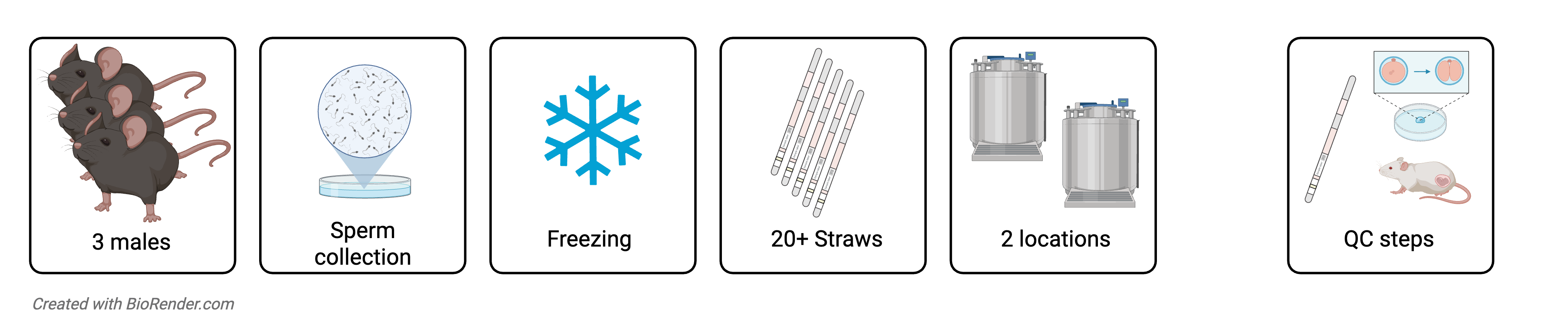
Description: Sperm is retrieved from the epididymal tissues of 3 male mice and is cryopreserved in 20 to 30 straws that are stored in liquid-phase, liquid nitrogen across two tanks in two separate locations (SRD and CCDD), to ensure sample safety and mitigate risks associated to unexpected or uncontrollable events.

Material needed: 3 males, reproductively active, 12-25 weeks old

Timeline: 2-6 weeks (dependant on QC method of choice)

Considerations: this method of cryopreservation is rapid and cheap; however, it only preserves half of the genome. This method is only recommended for single mutations on a common inbred background.

Quality Control: we provide different levels of Quality Control (QC) for different price ranges.

  1. Test thaw QC: we will thaw 1 straw the day after cryopreservation and visually assess motility and viability of the recovered sperm
  2. IVF and culture to blastocyst QC: we highly recommend this QC step. In addition to test thaw, we will also perform IVF and culture embryos up to blastocyst stage. We will provide the investigator with a fertility rate (%) for the recovered sperm. We will charge an extra cost to cover the IVF procedure.
  3. IVF and embryo transfer QC: In addition to test thaw, we will perform IVF and transfer 2-cell embryos into up to 3 pseudopregnant females to generate viable embryos/live pups. We will charge an extra cost to cover the IVF and embryo transfer procedures.

    Please note that we require you to provide your genotyping protocol, as well as full detail of the genetic content of each strain that you submit for cryopreservation.

Diagram of Sperm Cryopreservation

Embryo Cryopreservation:

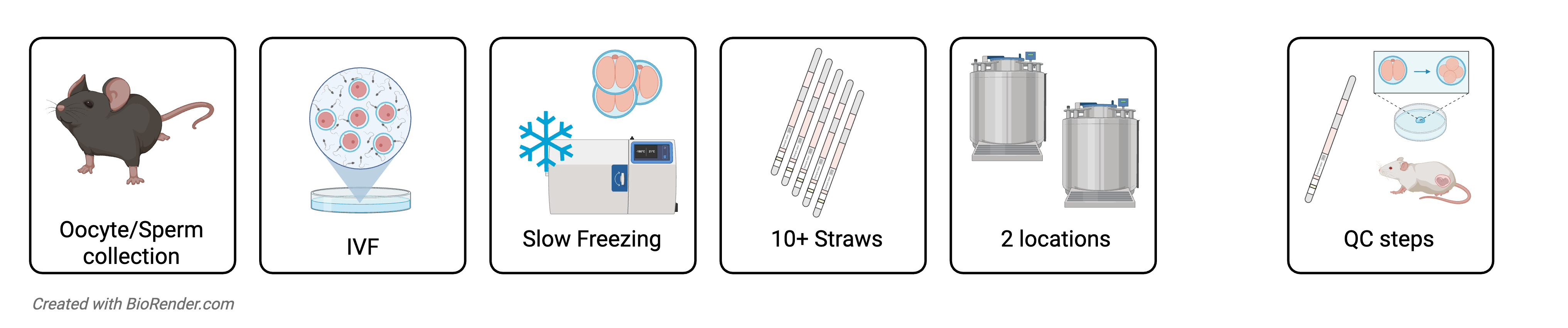
Description: Female mice are hormonally superovulated and oocytes are retrieved for in vitro fertilisation (IVF) with sperm from donor male. Resulting embryos are placed in cryoprotectant and loaded into multiple straws, which are gradually cooled and stored in liquid-phase liquid nitrogen in two separate tanks.

Material needed: Donor male and 8-10 donor females

Timeline: 12-15 weeks

Diagram of Embryo Cryopreservation

Embryonic Stem Cells Cryopreservation:

Not available, yet.

Oocyte Cryopreservation:

Not available, yet.

Cryostorage:

If you have cryopreserved mouse sperm/embryo/oocytes at another institution, we can cryostorage your samples for an annual fee. We do require that the investigator takes charge of shipping costs into our facility, and that thawing and genotyping protocols are submitted to the CIVM.

The CIVM stores all samples in liquid-phase liquid nitrogen tanks (CryoPlus1, ThermoFisher Scientific). Material retrieved from each strain is split between 2 tanks, a main and a backup tank, for redundancy. For additional safety, these 2 tanks are located in two separate buildings at ICR Sutton. Both tanks are continuously monitored by T-scan alarm systems and undergo annual service, as well as daily visual inspections.


Sperm Cryorecovery:

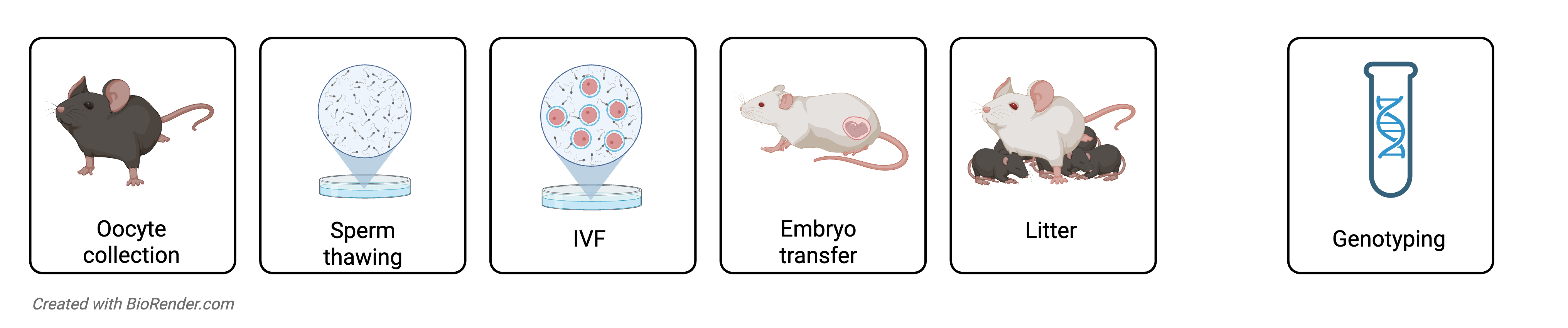
Description: Frozen sperm is cryorecovered by IVF, followed by embryo transfer. We can purchase wild-type female oocyte donors of the same genetic background, or alternatively the investigator can provide homozygous oocyte donors of the same strain.

Material needed: straw with frozen sperm and 8 to 12 females for IVF, 7-16 weeks old.

Timeline: 12-15 weeks

Diagram of Sperm Cryorecovery


Embryo Cryorecovery:

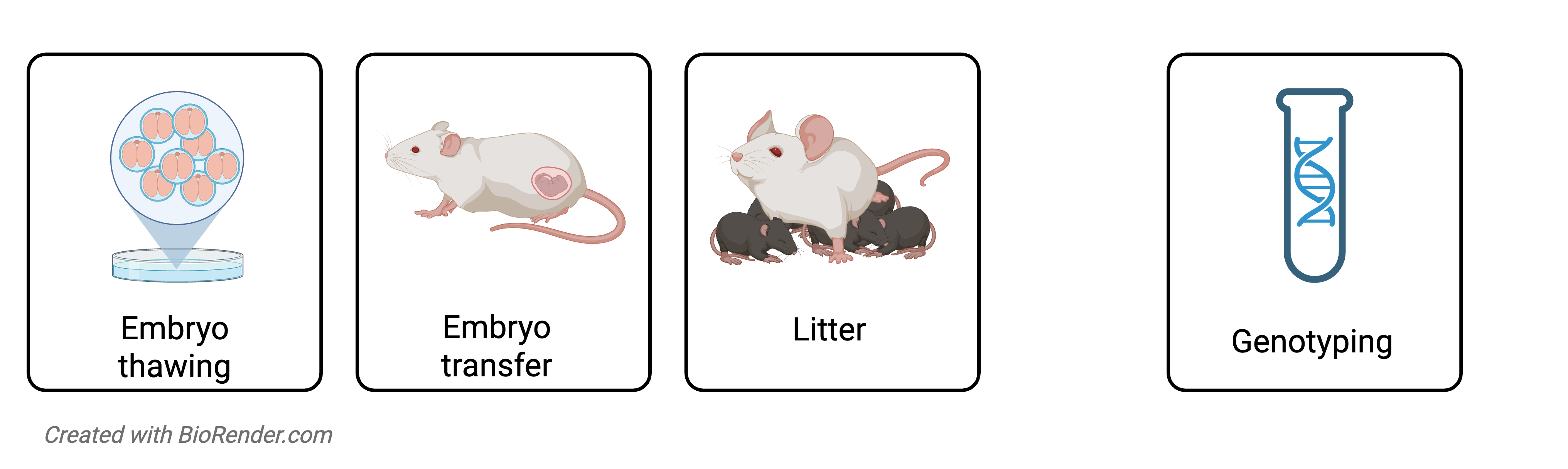
Description: Frozen 2-cell embryos are thawed and transferred into pseudopregnant females.

Material needed: straw(s) with frozen 2-cell embryos

Timeline: 8-10 week


Oocyte Cryorecovery:

Not available, yet.


Mouse rederivation

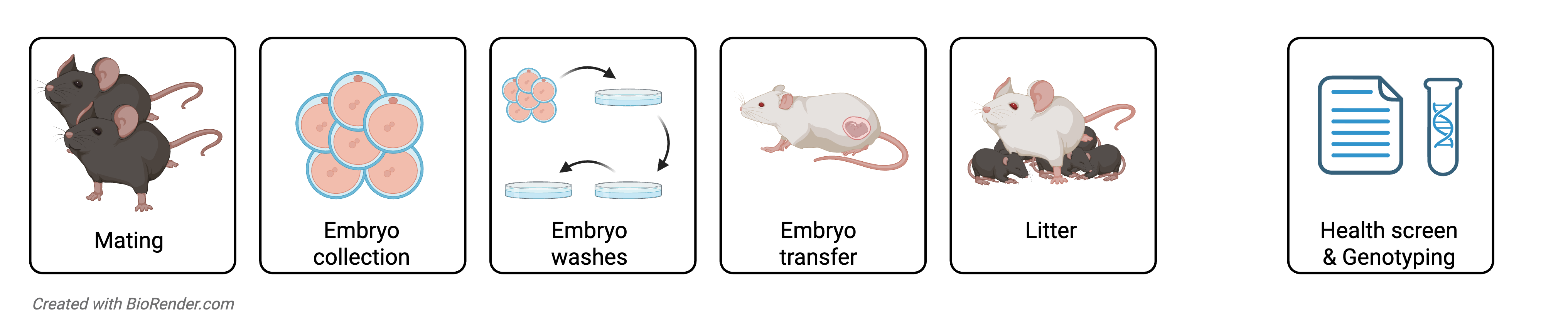
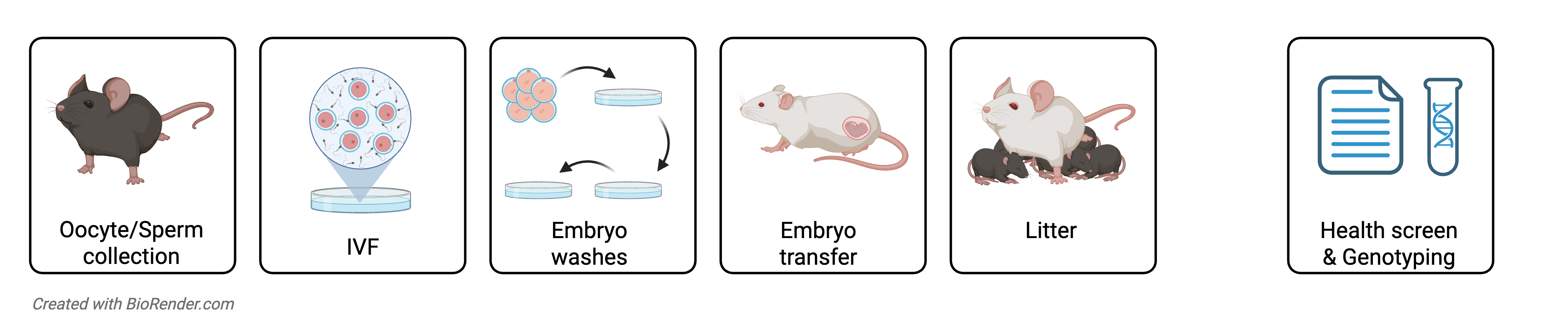
Description: Mouse rederivation is a process used to produce pathogen-free mouse colonies by removing microbial contaminants from existing lines. The procedure can be performed either through natural mating or in vitro fertilization (IVF):

  • In natural mating, embryos are obtained from donor mice and transferred into pathogen-free recipient females.
  • In IVF-based rederivation, fertilized embryos are created in vitro using gametes from donor mice and then implanted into clean recipient females.

Both methods effectively eliminate pathogens, allowing safe importation of mouse strains from lower health-status facilities into the ICR BSU. Samples from both litter and recipient mother will be sent for Health Screening and the associated costs will be charged separately to the Investigator.

Material needed: For IVF-based rederivation we require the investigator to provide 2 males, reproductively active, 12-25 weeks old, and the CIVM will purchase wild-type female egg-donors. Alternatively, if maintaining homozygosity is essential, the investigator will need to provide additional 6-10 females, 7-16 weeks old.

Timeline: 12-15 week

Mouse Rederivation Mating Diagram

Mouse Rederivation IVF diagram

We are currently setting up CRISPR/Cas9-based gene editing protocols. Soon, you’ll be able to apply for projects that involve developing new alleles based on:

  • Knockout by indel formation
  • Knockout by precise deletion
  • Conditional knockout
  • Knock-in of point mutations
  • Knock-in of small tags
  • Large knock-in
  • Exon replacement

These alleles will be developed based on Electroporation of Microinjection of CRISPR/Cas9 system reagents.

We will collaborate with you to design the best strategy and help you generate the genetically engineered mice you need for your project. 

We also provide:

  • Development of humanised mouse strains
  • Development of Patient-derived xenografts (PDX) and organoid models

Latest ICR News

18/12/25

In a major advance for molecular biology and cancer research, scientists have uncovered the molecular mechanisms that control a key step during the activation of cyclin-dependent kinases (CDKs) – the master regulators of cell division.

Specifically, the study provides high-resolution structural data that reveal how an enzyme called CDK-activating kinase (CAK) recognises CDKs through a newly identified interface, enabling their full activation. The discovery opens new avenues for therapeutic intervention in cancer, where CDK regulation is often disrupted.

The findings of the study, which was led by scientists at The Institute of Cancer Research, London, were published in the journal Science. The research was primarily funded by The Institute of Cancer Research (ICR), which is both a research institute and a charity. Additional funding came from the Medical Research Council and Cancer Research UK (CRUK).

Resolving long-standing puzzles

CDKs are enzymes that control the progression of cells through the cell cycle. Their activation typically requires two steps: binding to a cyclin partner and phosphorylation of a conserved threonine residue within the activation segment known as the T-loop. This phosphorylation is carried out by CAK, a complex composed of the proteins CDK7, cyclin H and MAT1.

As CDKs are known to be frequently dysregulated in cancer, they are prime targets for therapeutic intervention. Several next-generation therapeutics targeting the CAK, which aim to inhibit CDK activity by blocking T-loop phosphorylation, are currently undergoing clinical evaluation.

However, until now, it was not known how the CAK binds and recognises its CDK-type clients to activate them. A puzzling observation was that the sequence of the T-loop – the part of the CDK that actually receives the phosphorylation – does not appear to play a role in substrate recognition. How, then, does the CAK recognise its targets?

Cryo-EM reveals a critical interface

Using a powerful imaging technique called cryogenic electron microscopy (cryo-EM), the team determined the structures of CAK bound to CDK2, both when CDK2 is bound to a cyclin and when it is not.

The researchers were most interested in the interface between CDK2 and the CDK7 subunit of CAK, where they were able to identify two key clusters of molecular interactions in specific areas of the kinases. They also noted that the proteins interacted ‘head to head’ rather than ‘head to tail’ as previously thought.

Importantly, the T-loop of CDK2 did not contribute meaningfully to this interface, explaining how CAK can recognise CDKs independently of their T-loop sequence.

Together, these discoveries highlight the power of modern structural biology to provide answers to long-standing mechanistic questions.

Delving deeper

To validate their structural findings, the researchers introduced targeted mutations into the interaction clusters. They found that mutations in one particular region of the interface – called the C-lobe – prevented CDK7 from phosphorylating CDK2, thereby confirming the critical role of this area. Similarly, equivalent mutations in CDK2 that disrupted the interface prevented activation by CAK

These experiments demonstrate that the kinase-kinase interface itself is sufficient for substrate recognition, independent of the T-loop sequence, which then allows activation of the target CDK by phosphorylation.

The team then extended its analysis to other CDKs, including CDK1 and CDK11, both of which CAK is also known to act on during biochemical reactions. Cryo-EM structures of CAK bound to CDK1-cyclin B and CDK11 revealed nearly identical interfaces, suggesting that this mechanism is conserved across multiple CDKs.

Computational predictions supported this conclusion, showing similar interaction patterns for other CDKs that are being activated by CAK, but not for those that do not rely on CAK for activation. This suggests that the newly described interface represents a general architecture for CAK-mediated CDK activation.

Interestingly, the study also shed light on a second way in which CAK can interact with CDK-cyclin complexes: a particular sequence of amino acids at the very end of CDK7 can interact with cyclins. This sequence follows a known pattern of amino acids – known as a motif – and appears to be conserved across species, including fungi and plants. This sequence may play a role in the phosphorylation of CDK7 targets, or it may serve as a recognition signal for enzymes involved in regulating CAK itself.

“Even well-studied pathways can hold surprising secrets”

First author Victoria Cushing, formerly a PhD student in the Division of Structural Biology at the ICR, said:

“It will be interesting to explore the therapeutic potential of targeting the newly identified interface. We are hopeful that, in the longer term, key structural insights such as those achieved in this study will guide the design of new drugs that offer a new approach to modulating CDK activity.”

Senior author Dr Basil Greber, Group Leader of the Structural Biology of DNA Repair Complexes Group at the ICR, said:

“We were excited to see how neatly our structural results explain previous experimental observations. As we continue to explore the intricacies of kinase signalling, this study serves as a powerful reminder that even well-studied pathways that are central to cellular function hold secrets waiting to be uncovered.”

Image credit: Gerd Altmann from Pixabay