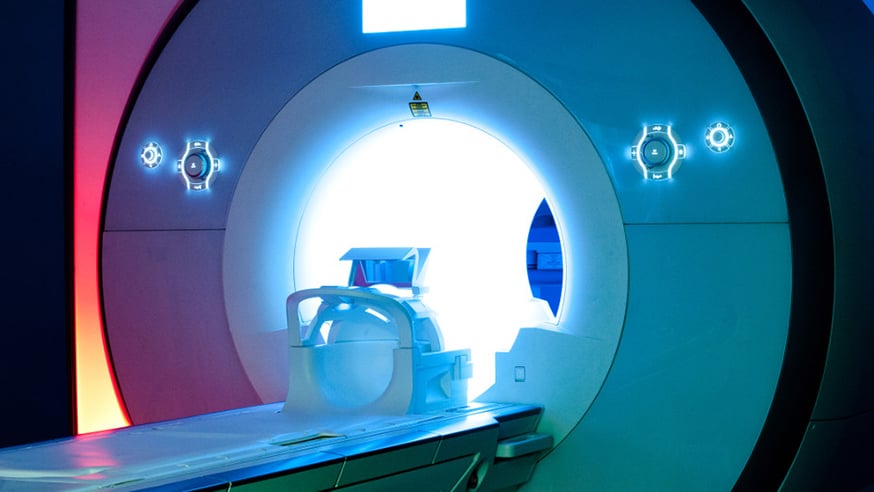
Image: An MRI scanner
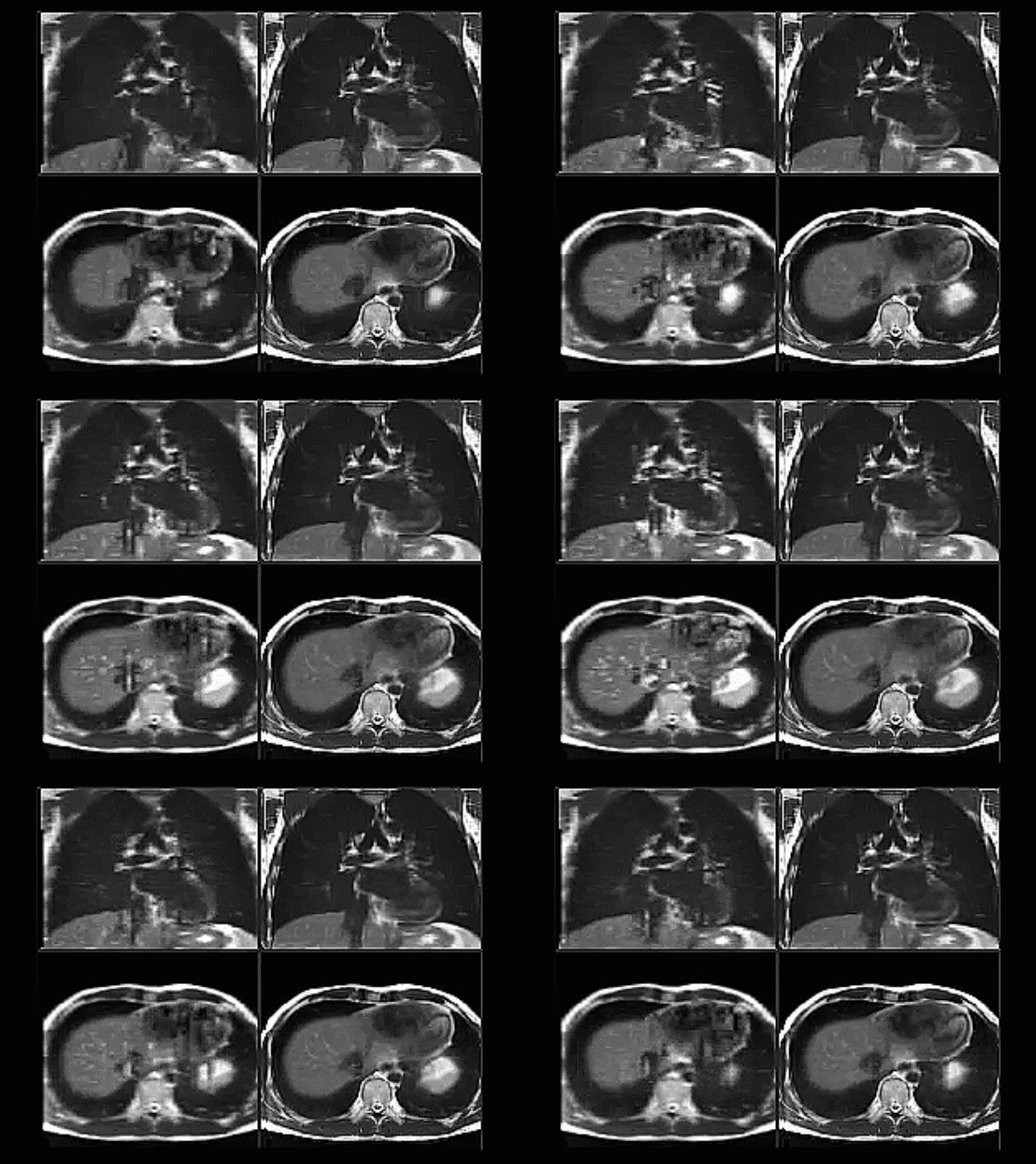
Physicists from The Institute of Cancer Research, London, and our partner hospital, The Royal Marsden NHS Foundation Trust, combined standard 2D magnetic resonance imaging (MRI) images of the chests of healthy volunteers to create 'super-resolution' videos, showing the lungs expanding and contracting.
The technique creates images of structures inside the body that are five times more detailed than other methods using MRI, and can also be carried out more quickly.
The new study, published in the journal Radiotherapy and Oncology, could help to deliver more precise radiotherapy for diseases like lung cancer by helping doctors to predict the location of a tumour more effectively, even as it moves.
It also shows the potential of a specific type of MRI called T2-weighted MRI in dual imaging and radiotherapy systems that aim to image and treat tumours simultaneously – like the MR-Linac, which is being developed by researchers including physicists at the ICR and The Royal Marsden.
The ICR's MR Linac machine combines two technologies to tailor the shape of X-ray beams in real time and accurately deliver doses of radiation.
Animation: 3D super-resolution MRI scans
More accurate radiotherapy
In the study, which was largely funded by Cancer Research UK, eight healthy volunteers were scanned using standard MRI.
Images were sorted and stitched together by computer to build accurate, high resolution movies of them breathing in and out.
The technique developed by ICR researchers also reproduces detailed images of 'slices' of the body, at any position or time, by combining multiple MRIs of the body from different orientations.
The high definition images also have fewer 'artefacts' than standard MRI images – visible glitches caused by missing data that can obscure important structures in the body, compared with other similar techniques.
The technique could help to plan more accurate radiotherapy that could be adapted throughout the course of treatment as tumours shrink.
“New technique”
Team leader Professor Martin Leach said: “Radiotherapy treatment for lung cancer is currently planned using CT scans of patients to measure their breathing patterns, but it's hard to see the tumour on these images and so the radiotherapy delivered may not be effectively treating the cancer.”
Lead author Dr Andreas Wetscherek (from the Radiotherapy Physics Modelling Team), said: “Our study describes the development of a new technique for rebuilding static MRI images into moving videos, which could give MRI the edge over CT scans in the future planning of radiotherapy treatment.
“It also shows the potential of moving T2 weighted MRI for systems like the MR Linac, which are being designed to image and treat patients with radiotherapy at the same time.”