
Centre for In Vivo Modelling Service Core

At the Centre for In Vivo Modelling (CIVM), we combine advanced animal genetics and cutting-edge technologies to drive cancer research. Our multidisciplinary team specialises in the generation and maintenance of genetically engineered mouse models (GEMMs), humanised mouse strains, and patient-derived models (xenografts and organoids), using innovations such as CRISPR gene editing, embryo manipulation, and in vivo genetic screening. We develop and cryopreserve new cancer models that closely replicate human disease, supporting translational studies that inform effective therapies. Our approach integrates rigorous scientific standards, ethical oversight, and collaborative expertise, aiming to accelerate progress in understanding cancer biology and developing better treatments for patients.

Our Centre is dedicated to driving innovation and excellence in cancer research through advanced in vivo modelling. We work in close collaboration with the ICR researchers and clinicians at The Royal Marsden to generate genetically engineered mouse models (GEMMs) and patient-derived models, such as patient-derived xenografts (PDXs) and patient-derived organoids (PDOs) to interrogate cancer biology in its own ecosystem. By leveraging these sophisticated in vivo systems, the Centre aims to:

  • Develop innovative cancer models in collaboration with ICR researchers to advance cancer research and drug discovery.
  • Work in partnership with The Royal Marsden Hospital to obtain patient samples and generate new patient-derived cancer models for translational studies.
  • Foster close interdisciplinary collaboration with drug discovery teams to leverage these in vivo models in the creation and testing of next-generation anti-cancer therapies.
  • Continuously improve the sophistication and relevance of our cancer models, ensuring they more faithfully recapitulate the complexity of human disease and enhance the translational impact of our research.


Our services

Advantages of cryopreserving your strains:

  • Allows you to save space, by getting the mice you need, when you need;
  • Reduces your animal costs;
  • Reduces animal use;
  • Reduces risk from disasters (e.g. disease outbreaks, breeding cessation, equipment failures, genetic contamination, natural disasters, etc…).

 What can be cryopreserved?

  • Mouse Sperm
  • Mouse Embryos
  • Mouse Embryonic Stem Cells
  • Mouse Oocytes

 Sperm Cryopreservation:

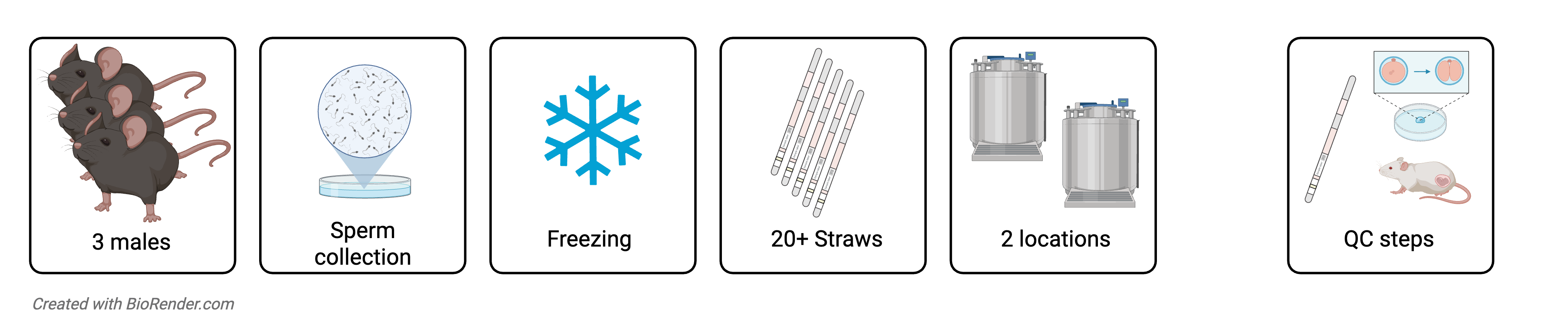
Description: Sperm is retrieved from the epididymal tissues of 3 male mice and is cryopreserved in 20 to 30 straws that are stored in liquid-phase, liquid nitrogen across two tanks in two separate locations (SRD and CCDD), to ensure sample safety and mitigate risks associated to unexpected or uncontrollable events.

Material needed: 3 males, reproductively active, 12-25 weeks old

Timeline: 2-6 weeks (dependant on QC method of choice)

Considerations: this method of cryopreservation is rapid and cheap; however, it only preserves half of the genome. This method is only recommended for single mutations on a common inbred background.

Quality Control: we provide different levels of Quality Control (QC) for different price ranges.

  1. Test thaw QC: we will thaw 1 straw the day after cryopreservation and visually assess motility and viability of the recovered sperm
  2. IVF and culture to blastocyst QC: we highly recommend this QC step. In addition to test thaw, we will also perform IVF and culture embryos up to blastocyst stage. We will provide the investigator with a fertility rate (%) for the recovered sperm. We will charge an extra cost to cover the IVF procedure.
  3. IVF and embryo transfer QC: In addition to test thaw, we will perform IVF and transfer 2-cell embryos into up to 3 pseudopregnant females to generate viable embryos/live pups. We will charge an extra cost to cover the IVF and embryo transfer procedures.

    Please note that we require you to provide your genotyping protocol, as well as full detail of the genetic content of each strain that you submit for cryopreservation.

Diagram of Sperm Cryopreservation

Embryo Cryopreservation:

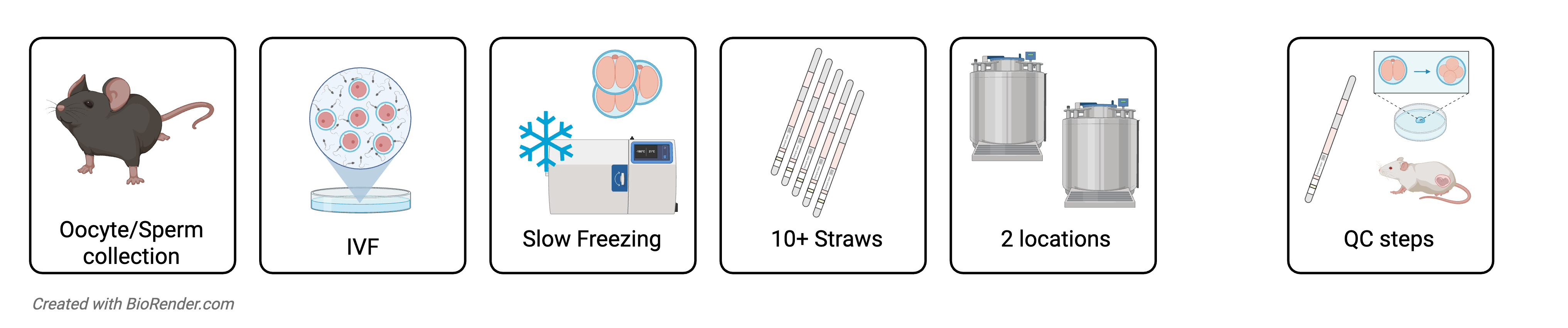
Description: Female mice are hormonally superovulated and oocytes are retrieved for in vitro fertilisation (IVF) with sperm from donor male. Resulting embryos are placed in cryoprotectant and loaded into multiple straws, which are gradually cooled and stored in liquid-phase liquid nitrogen in two separate tanks.

Material needed: Donor male and 8-10 donor females

Timeline: 12-15 weeks

Diagram of Embryo Cryopreservation

Embryonic Stem Cells Cryopreservation:

Not available, yet.

Oocyte Cryopreservation:

Not available, yet.

Cryostorage:

If you have cryopreserved mouse sperm/embryo/oocytes at another institution, we can cryostorage your samples for an annual fee. We do require that the investigator takes charge of shipping costs into our facility, and that thawing and genotyping protocols are submitted to the CIVM.

The CIVM stores all samples in liquid-phase liquid nitrogen tanks (CryoPlus1, ThermoFisher Scientific). Material retrieved from each strain is split between 2 tanks, a main and a backup tank, for redundancy. For additional safety, these 2 tanks are located in two separate buildings at ICR Sutton. Both tanks are continuously monitored by T-scan alarm systems and undergo annual service, as well as daily visual inspections.


Sperm Cryorecovery:

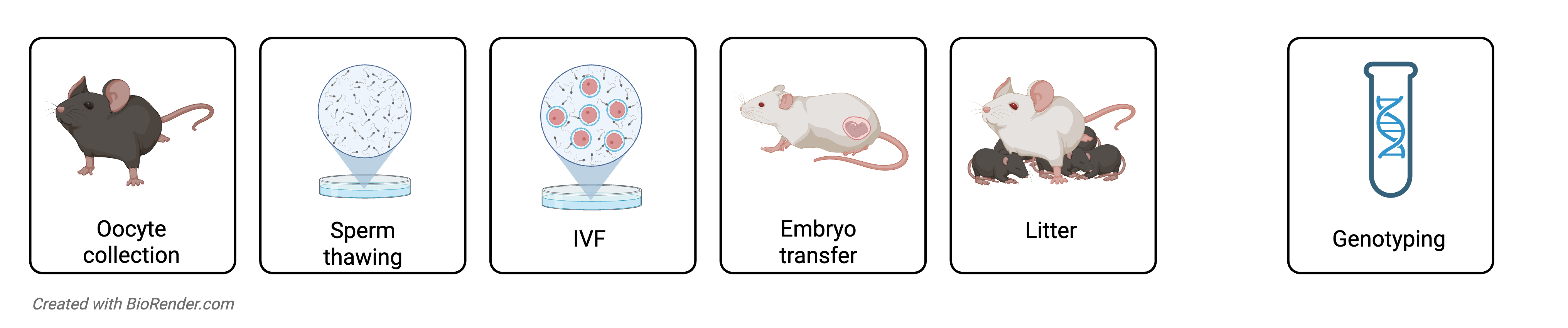
Description: Frozen sperm is cryorecovered by IVF, followed by embryo transfer. We can purchase wild-type female oocyte donors of the same genetic background, or alternatively the investigator can provide homozygous oocyte donors of the same strain.

Material needed: straw with frozen sperm and 8 to 12 females for IVF, 7-16 weeks old.

Timeline: 12-15 weeks

Diagram of Sperm Cryorecovery


Embryo Cryorecovery:

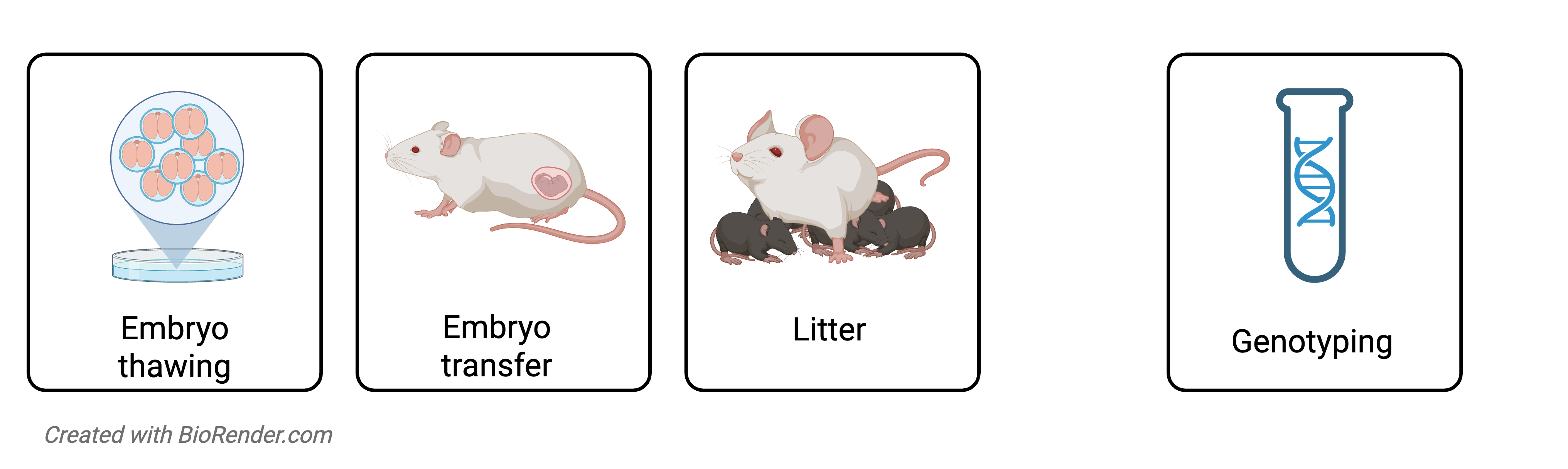
Description: Frozen 2-cell embryos are thawed and transferred into pseudopregnant females.

Material needed: straw(s) with frozen 2-cell embryos

Timeline: 8-10 week


Oocyte Cryorecovery:

Not available, yet.


Mouse rederivation

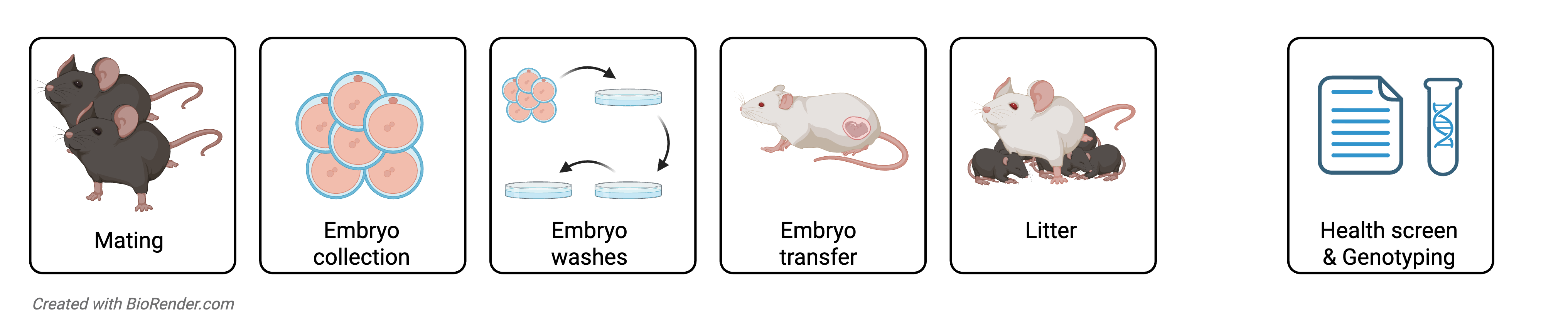
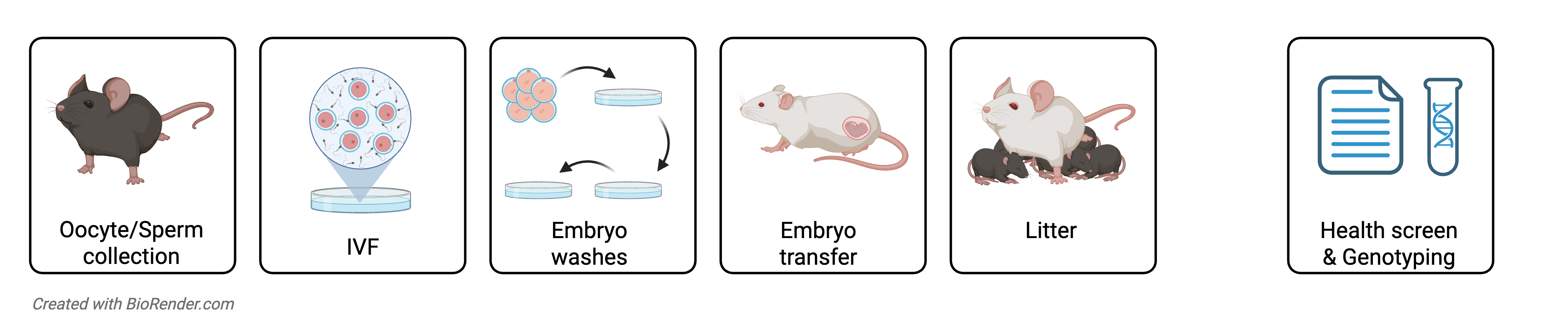
Description: Mouse rederivation is a process used to produce pathogen-free mouse colonies by removing microbial contaminants from existing lines. The procedure can be performed either through natural mating or in vitro fertilization (IVF):

  • In natural mating, embryos are obtained from donor mice and transferred into pathogen-free recipient females.
  • In IVF-based rederivation, fertilized embryos are created in vitro using gametes from donor mice and then implanted into clean recipient females.

Both methods effectively eliminate pathogens, allowing safe importation of mouse strains from lower health-status facilities into the ICR BSU. Samples from both litter and recipient mother will be sent for Health Screening and the associated costs will be charged separately to the Investigator.

Material needed: For IVF-based rederivation we require the investigator to provide 2 males, reproductively active, 12-25 weeks old, and the CIVM will purchase wild-type female egg-donors. Alternatively, if maintaining homozygosity is essential, the investigator will need to provide additional 6-10 females, 7-16 weeks old.

Timeline: 12-15 week

Mouse Rederivation Mating Diagram

Mouse Rederivation IVF diagram

We are currently setting up CRISPR/Cas9-based gene editing protocols. Soon, you’ll be able to apply for projects that involve developing new alleles based on:

  • Knockout by indel formation
  • Knockout by precise deletion
  • Conditional knockout
  • Knock-in of point mutations
  • Knock-in of small tags
  • Large knock-in
  • Exon replacement

These alleles will be developed based on Electroporation of Microinjection of CRISPR/Cas9 system reagents.

We will collaborate with you to design the best strategy and help you generate the genetically engineered mice you need for your project. 

We also provide:

  • Development of humanised mouse strains
  • Development of Patient-derived xenografts (PDX) and organoid models

Latest ICR News

11/02/26

A team of scientists at The Institute of Cancer Research, London, has developed a repeatable three-dimensional (3D) imaging technique that could transform preclinical cancer studies. The researchers have demonstrated that a specialised form of ultrasound imaging, which maps tissue stiffness, can reliably measure mechanical changes in cancerous lesions, even under challenging real‑world conditions.

Increased tissue stiffness is associated with cancer, and tumours often become stiffer both as they grow and as their internal structure transforms. These mechanical changes can influence how cancers respond to treatment and how they spread.

For years, researchers have sought imaging tools sensitive enough to detect subtle differences in stiffness in animal models. The new study confirms that a technique called vibrational shear wave elastography (VSWE), which is being developed at The Institute of Cancer Research (ICR), may meet that need.

The study findings, published in the journal Physics in Medicine & Biology, could pave the way for more consistent use of biomechanical imaging in the early testing of cancer therapies. This research was supported by Cancer Research UK.

Why tumour stiffness matters in cancer research

When tumours stiffen, it is often because the extracellular matrix – the dense scaffold surrounding cancer cells – becomes thicker or more crosslinked. These changes can reduce the delivery of oxygen and anti‑cancer drugs, impede immune cell movement and, ultimately, make tumours more aggressive. Being able to measure stiffness non‑invasively allows researchers to understand these processes over time and to assess whether treatments are successfully reversing harmful mechanical changes.

Ultrasound shear wave elastography has become a mainstay technique in human medicine, where it is used to evaluate liver disease and breast lesions. However, applying the method to preclinical research is much more challenging. Small tumours – often only a few millimetres across – sit close to the skin and move with every breath the animal takes. These factors can affect measurement repeatability.

The team behind the new study sought to address this by using continuous harmonic vibrations delivered externally, rather than traditional ultrasound-generated “push” pulses. This external vibration approach offers better control of frequency and amplitude, making it potentially more reliable in tiny structures.

Testing consistency across real‑world conditions

The researchers implanted human breast cancer cells into the flanks of four mice. Once tumours reached about 500 cubic millimetres in size, each mouse underwent a series of imaging sessions across three consecutive days. During each session, the team varied three key conditions that could affect repeatability: vibration frequency, tumour orientation and type of anaesthesia (both of which can affect breathing motion).

The aim was to test not only how repeatable the measurements were, but also how much each practical variable altered the results.

To obtain 3D images, a high-frequency ultrasound probe was moved across the tumour, capturing a “stack” of slices that could be reconstructed into a full volumetric map of shear wave speed (SWS). Higher wave speeds indicate stiffer tissue.

Vibration frequency strongly influenced the results

Across the 138 datasets collected, the researchers found several notable patterns.

Firstly, they noted that measurements at 500 Hz showed the lowest variability and most consistent penetration of shear waves. At 1,000 Hz, variability increased substantially because the higher-frequency waves attenuated too quickly, reducing data quality.

The other two variables – anaesthesia and tumour orientation – had less effect on repeatability, and the researchers were able to conclude that differences in these factors did not significantly affect the stiffness measurements.

Importantly, the study showed that stiffness differences between tumours were clear and consistent. A statistical analysis confirmed significant variations in stiffness between different tumours, meaning that VSWE was able to repeatedly detect differences rather than image distortions caused by environmental interference.

In addition, the method produced highly correlated 3D maps across multiple days when scanning the same tumour under similar conditions. Spatial patterns remained stable despite growth in tumour size, confirming the technique’s reliability for longitudinal studies.

What this means for future cancer research

The study provides compelling evidence that VSWE can be used reliably to monitor how tumours respond to treatment over time. The technique’s resilience to breathing motion is particularly encouraging, as this is difficult to control perfectly in animal studies.

The findings also highlight the value of using the external vibration in preclinical elastography. Although higher frequencies promise greater spatial resolution, lower frequencies are better suited to tumour tissues that attenuate shear waves more strongly.

A promising tool for the preclinical imaging toolkit

As researchers increasingly focus on the mechanical environment of tumours – both as a biomarker and as a therapeutic target – the need for reliable, repeatable biomechanical imaging grows. The new findings suggest that VWSE, with its tuneable vibration frequencies, may become a cornerstone method for tracking how tumours evolve and respond in vivo.

First author John Civale, Senior Scientific Officer in the Division of Radiotherapy and Imaging at the ICR, said: “We were reassured to see just how robust the method proved to be. Despite the complexities of imaging tiny tumours in living animals, the day‑to‑day consistency of the measurements was remarkably strong.

“We’re now looking at ways to incorporate more sophisticated image‑registration methods that account for changes in tumour size and shape. This will help us detect even more subtle biomechanical changes during treatment.”

Senior author Dr Emma Harris, Group Leader of the Imaging for Radiotherapy Adaptation Group at the ICR, said:

“This study represents an advance on other repeatability studies where usually only mean values of shear weave speed are reported. Our results therefore provide a benchmark for other elastography studies.

“Once further refined, our technique could, if adopted more widely, accelerate the development of treatments aimed at altering tumour stiffness, improving drug delivery and ultimately improving outcomes for patients."

Image credit: Pete Linforth from Pixabay