
Centre for In Vivo Modelling Service Core

At the Centre for In Vivo Modelling (CIVM), we combine advanced animal genetics and cutting-edge technologies to drive cancer research. Our multidisciplinary team specialises in the generation and maintenance of genetically engineered mouse models (GEMMs), humanised mouse strains, and patient-derived models (xenografts and organoids), using innovations such as CRISPR gene editing, embryo manipulation, and in vivo genetic screening. We develop and cryopreserve new cancer models that closely replicate human disease, supporting translational studies that inform effective therapies. Our approach integrates rigorous scientific standards, ethical oversight, and collaborative expertise, aiming to accelerate progress in understanding cancer biology and developing better treatments for patients.

Our Centre is dedicated to driving innovation and excellence in cancer research through advanced in vivo modelling. We work in close collaboration with the ICR researchers and clinicians at The Royal Marsden to generate genetically engineered mouse models (GEMMs) and patient-derived models, such as patient-derived xenografts (PDXs) and patient-derived organoids (PDOs) to interrogate cancer biology in its own ecosystem. By leveraging these sophisticated in vivo systems, the Centre aims to:

  • Develop innovative cancer models in collaboration with ICR researchers to advance cancer research and drug discovery.
  • Work in partnership with The Royal Marsden Hospital to obtain patient samples and generate new patient-derived cancer models for translational studies.
  • Foster close interdisciplinary collaboration with drug discovery teams to leverage these in vivo models in the creation and testing of next-generation anti-cancer therapies.
  • Continuously improve the sophistication and relevance of our cancer models, ensuring they more faithfully recapitulate the complexity of human disease and enhance the translational impact of our research.


Our services

Advantages of cryopreserving your strains:

  • Allows you to save space, by getting the mice you need, when you need;
  • Reduces your animal costs;
  • Reduces animal use;
  • Reduces risk from disasters (e.g. disease outbreaks, breeding cessation, equipment failures, genetic contamination, natural disasters, etc…).

 What can be cryopreserved?

  • Mouse Sperm
  • Mouse Embryos
  • Mouse Embryonic Stem Cells
  • Mouse Oocytes

 Sperm Cryopreservation:

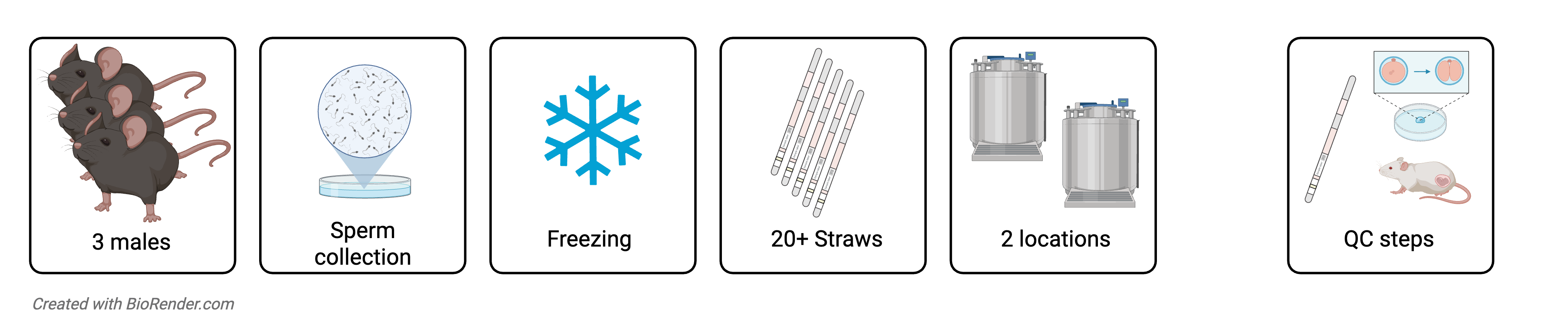
Description: Sperm is retrieved from the epididymal tissues of 3 male mice and is cryopreserved in 20 to 30 straws that are stored in liquid-phase, liquid nitrogen across two tanks in two separate locations (SRD and CCDD), to ensure sample safety and mitigate risks associated to unexpected or uncontrollable events.

Material needed: 3 males, reproductively active, 12-25 weeks old

Timeline: 2-6 weeks (dependant on QC method of choice)

Considerations: this method of cryopreservation is rapid and cheap; however, it only preserves half of the genome. This method is only recommended for single mutations on a common inbred background.

Quality Control: we provide different levels of Quality Control (QC) for different price ranges.

  1. Test thaw QC: we will thaw 1 straw the day after cryopreservation and visually assess motility and viability of the recovered sperm
  2. IVF and culture to blastocyst QC: we highly recommend this QC step. In addition to test thaw, we will also perform IVF and culture embryos up to blastocyst stage. We will provide the investigator with a fertility rate (%) for the recovered sperm. We will charge an extra cost to cover the IVF procedure.
  3. IVF and embryo transfer QC: In addition to test thaw, we will perform IVF and transfer 2-cell embryos into up to 3 pseudopregnant females to generate viable embryos/live pups. We will charge an extra cost to cover the IVF and embryo transfer procedures.

    Please note that we require you to provide your genotyping protocol, as well as full detail of the genetic content of each strain that you submit for cryopreservation.

Diagram of Sperm Cryopreservation

Embryo Cryopreservation:

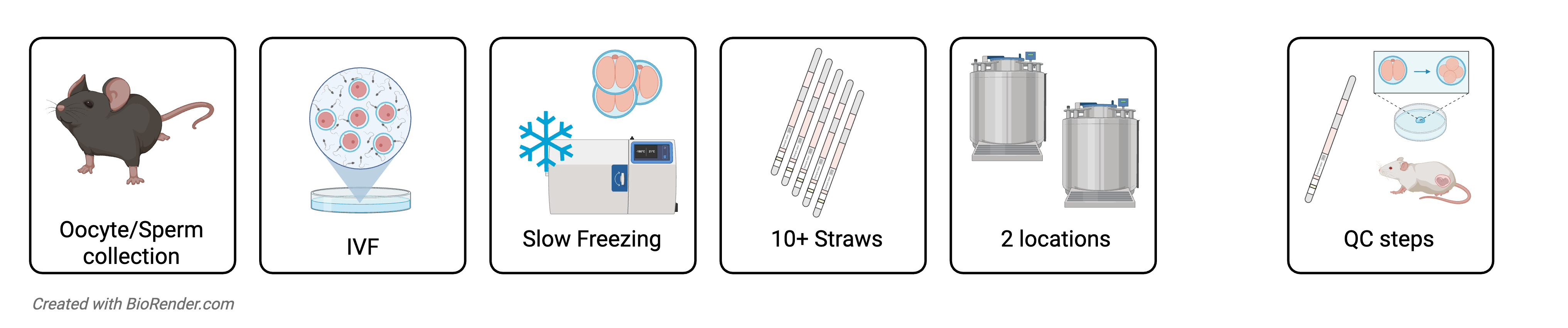
Description: Female mice are hormonally superovulated and oocytes are retrieved for in vitro fertilisation (IVF) with sperm from donor male. Resulting embryos are placed in cryoprotectant and loaded into multiple straws, which are gradually cooled and stored in liquid-phase liquid nitrogen in two separate tanks.

Material needed: Donor male and 8-10 donor females

Timeline: 12-15 weeks

Diagram of Embryo Cryopreservation

Embryonic Stem Cells Cryopreservation:

Not available, yet.

Oocyte Cryopreservation:

Not available, yet.

Cryostorage:

If you have cryopreserved mouse sperm/embryo/oocytes at another institution, we can cryostorage your samples for an annual fee. We do require that the investigator takes charge of shipping costs into our facility, and that thawing and genotyping protocols are submitted to the CIVM.

The CIVM stores all samples in liquid-phase liquid nitrogen tanks (CryoPlus1, ThermoFisher Scientific). Material retrieved from each strain is split between 2 tanks, a main and a backup tank, for redundancy. For additional safety, these 2 tanks are located in two separate buildings at ICR Sutton. Both tanks are continuously monitored by T-scan alarm systems and undergo annual service, as well as daily visual inspections.


Sperm Cryorecovery:

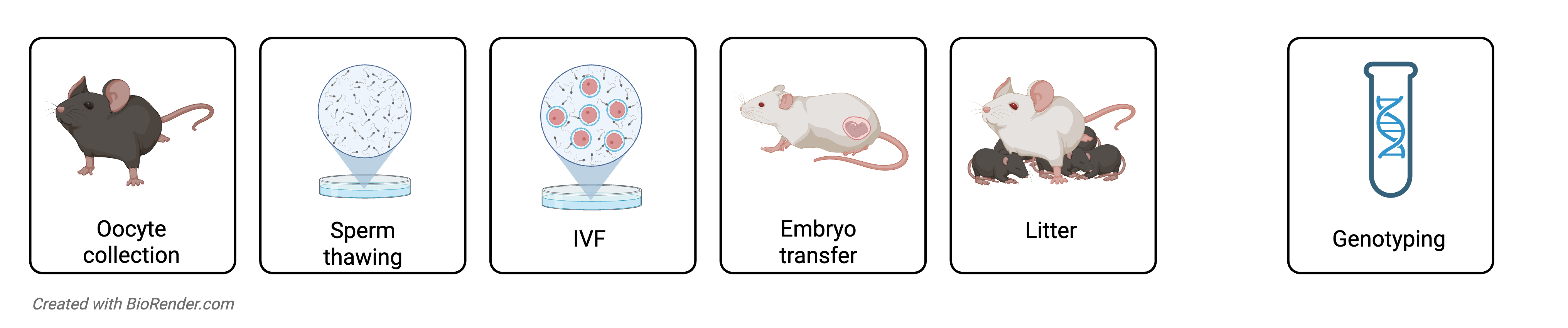
Description: Frozen sperm is cryorecovered by IVF, followed by embryo transfer. We can purchase wild-type female oocyte donors of the same genetic background, or alternatively the investigator can provide homozygous oocyte donors of the same strain.

Material needed: straw with frozen sperm and 8 to 12 females for IVF, 7-16 weeks old.

Timeline: 12-15 weeks

Diagram of Sperm Cryorecovery


Embryo Cryorecovery:

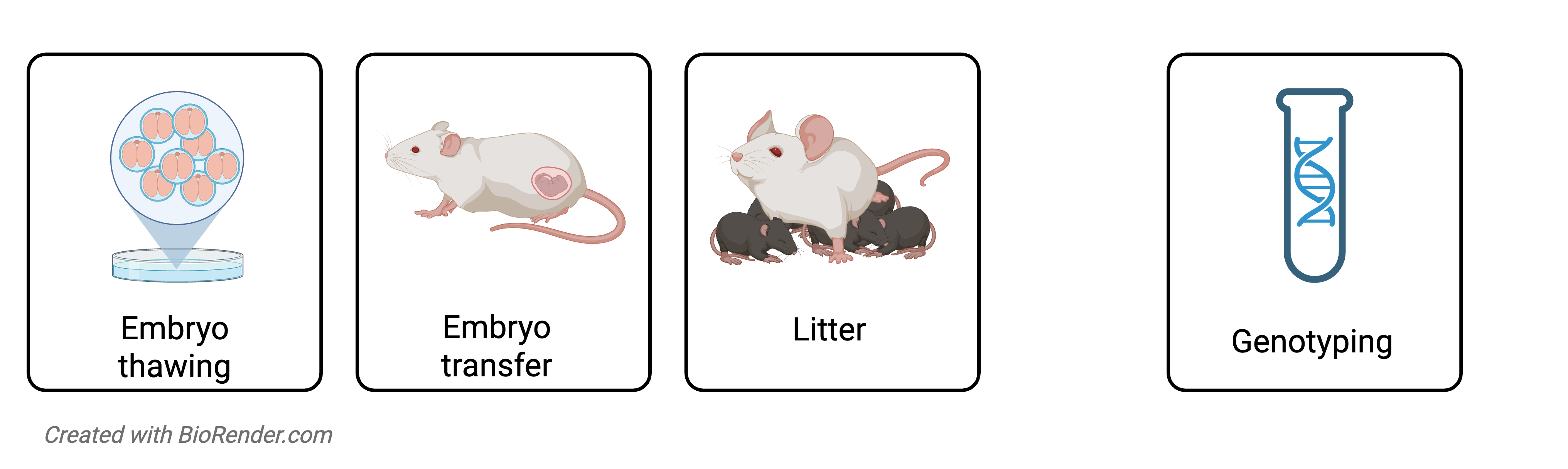
Description: Frozen 2-cell embryos are thawed and transferred into pseudopregnant females.

Material needed: straw(s) with frozen 2-cell embryos

Timeline: 8-10 week


Oocyte Cryorecovery:

Not available, yet.


Mouse rederivation

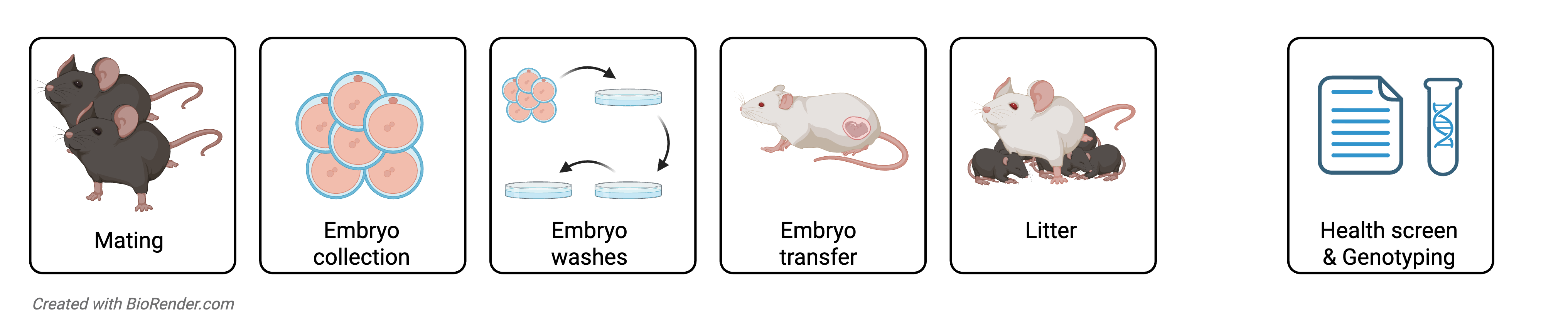
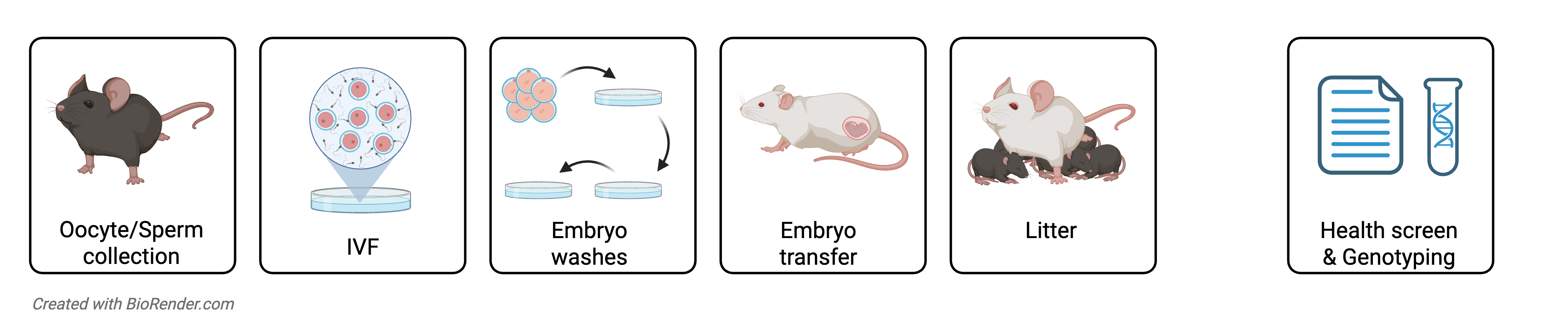
Description: Mouse rederivation is a process used to produce pathogen-free mouse colonies by removing microbial contaminants from existing lines. The procedure can be performed either through natural mating or in vitro fertilization (IVF):

  • In natural mating, embryos are obtained from donor mice and transferred into pathogen-free recipient females.
  • In IVF-based rederivation, fertilized embryos are created in vitro using gametes from donor mice and then implanted into clean recipient females.

Both methods effectively eliminate pathogens, allowing safe importation of mouse strains from lower health-status facilities into the ICR BSU. Samples from both litter and recipient mother will be sent for Health Screening and the associated costs will be charged separately to the Investigator.

Material needed: For IVF-based rederivation we require the investigator to provide 2 males, reproductively active, 12-25 weeks old, and the CIVM will purchase wild-type female egg-donors. Alternatively, if maintaining homozygosity is essential, the investigator will need to provide additional 6-10 females, 7-16 weeks old.

Timeline: 12-15 week

Mouse Rederivation Mating Diagram

Mouse Rederivation IVF diagram

We are currently setting up CRISPR/Cas9-based gene editing protocols. Soon, you’ll be able to apply for projects that involve developing new alleles based on:

  • Knockout by indel formation
  • Knockout by precise deletion
  • Conditional knockout
  • Knock-in of point mutations
  • Knock-in of small tags
  • Large knock-in
  • Exon replacement

These alleles will be developed based on Electroporation of Microinjection of CRISPR/Cas9 system reagents.

We will collaborate with you to design the best strategy and help you generate the genetically engineered mice you need for your project. 

We also provide:

  • Development of humanised mouse strains
  • Development of Patient-derived xenografts (PDX) and organoid models

Latest ICR News

29/01/26

Scientists have unveiled a ground-breaking approach to tackling one of cancer biology’s most elusive targets: the protein LMO2, a key driver of T-cell acute lymphoblastic leukaemia (T‑ALL).

T‑ALL is a fast-growing cancer of the white blood cells that primarily affects children and young adults. Although survival rates have improved with chemotherapy, relapse remains a major challenge, and targeted therapies are urgently needed.

The researchers behind the current study have introduced a novel platform that should accelerate the discovery of new drugs against LMO2 and other transcription factors – proteins that help control which genes are switched on or off.

This innovation could pave the way for therapies against a class of proteins long considered “undruggable”, offering hope for patients with aggressive forms of leukaemia.

The study was led by scientists at The Institute of Cancer Research, London, and the findings were published in the journal eLife. The work was primarily funded by Blood Cancer UK, with additional funding provided by Cancer Research UK and The Institute of Cancer Research (ICR), which is both a research institute and a charity.

LMO2 is a key target

Among the molecular culprits behind T‑ALL, LMO2 stands out. Its abnormal activation is a hallmark of this disease, with more than half of T-ALL patients having LMO2-expressing tumours. Yet for decades, LMO2 has resisted all attempts at direct drug targeting.

The difficulty lies in LMO2’s structure, or rather, its lack of one. Unlike enzymes or receptors with well-defined shapes, LMO2 is intrinsically disordered, meaning it doesn’t fold into a rigid three-dimensional form. This flexibility, which is essential for LMO2’s biological role, makes it nearly impossible for traditional drugs to latch onto the protein. Conventional small molecules and antibodies rely on binding to stable pockets or surfaces, and they simply cannot get a grip on LMO2.

In healthy cells, LMO2 plays a vital role in blood cell development. It acts as a scaffold, bridging together other proteins – such as TAL1, E47 and GATA factors – into a transcriptional complex that regulates gene expression. In leukaemia, however, LMO2 becomes hijacked by chromosomal rearrangements or mutations that crank up its production. The result is an oncogenic machine that drives uncontrolled cell growth.

Exploiting cellular mechanisms

Until now, dismantling this machine seemed impossible. However, in this study, the researchers have devised a clever workaround: instead of trying to block LMO2’s activity, they set out to destroy it altogether. This strategy hinges on two complementary technologies that exploit the cell’s own waste-disposal system – intracellular antibodies and proteolysis targeting chimeras (PROTACs).

The first approach involves engineering an intracellular antibody fragment, known as an iDAb, that binds tightly to LMO2. This fragment is fused to an E3 ubiquitin ligase, an enzyme that tags proteins for destruction. Once inside the cell, the fusion protein latches onto LMO2 and marks it for degradation by the proteasome, the cell’s protein-recycling machinery. In laboratory tests, this “biodegrader” efficiently eliminated LMO2 from leukaemia cells.

What was particularly interesting was that removing LMO2 didn’t just erase one protein – it caused the entire transcriptional complex to collapse. TAL1 and E47, which depend on LMO2 for stability, were also degraded. This phenomenon, dubbed “collateral breakdown”, amplifies the therapeutic effect: by targeting a single scaffold protein, the strategy can dismantle an entire oncogenic network.

To make the approach more drug-like, the team also developed small molecules called antibody-derived compounds (Abd). These mimic the binding properties of the iDAb and were converted into PROTACs – bifunctional molecules that link the target protein to an E3 ligase.

Like the antibody-based biodegrader, these Abd PROTACs successfully degraded LMO2 in T‑ALL cell lines, triggering programmed cell death. Importantly, cells lacking LMO2 were unaffected, underscoring the specificity of the treatment.

Hope on the horizon

Of course, challenges remain. The current work serves as proof of concept, conducted in cell cultures. Moving towards clinical application will require optimising these molecules for stability, delivery and safety in living organisms. Researchers will need to ensure that the biodegraders do not inadvertently target other proteins and that they can reach leukaemia cells in the body without harming healthy tissues.

Still, the promise is undeniable. Targeted protein degradation is already making waves in drug development, with several PROTAC-based therapies in clinical trials for other diseases. Extending this technology to transcription factors – a class of proteins long considered untouchable – could revolutionise cancer treatment.

For patients with T‑ALL, this research represents hope on the horizon. While much work lies ahead, the ability to target LMO2 marks a turning point. As scientists refine these strategies and take them towards clinical trials, the prospect of more precise, less toxic treatments for leukaemia grows ever closer.

“The implications are profound”

First author Dr Naphannop (Nikki) Sereesongsaeng, Senior Scientific Officer in the Division of Cancer Therapeutics at the ICR, said:

“For decades, intrinsically disordered proteins like LMO2 have been considered beyond the reach of pharmacology. This study shows that targeted degradation can overcome that barrier, even interrupting entire protein complexes.

“We hope that our Abd technology will help other researchers explore this approach to tackling intrinsically disordered proteins – not only in leukaemia and other cancers driven by similar assembles but also in clinical indications such as inflammation, infection and neurological diseases.”

Professor Terence Rabbitts, Group Leader of the Chromosomal Translocations and Intracellular Antibody Therapeutics Group at the ICR, said:

“Beyond its therapeutic potential, the study emphasises susceptible features in cancer biology. It highlights the fragility of oncogenic complexes and suggests that removing a single keystone protein can topple the entire structure. This insight could inspire a new generation of drugs designed not just to inhibit, but to dismantle, the molecular machines that sustain cancer. In particular, the new technology can be applied to tumour-specific chromosomal translocation fusion proteins, which are frequently transcription factors. The implications are profound.”

Focusing on technology development, by combining antibody engineering, chemical innovation and the cell’s own disposal system, researchers have cracked a problem that stymied cancer science for decades. Their achievement is not only a technical triumph but also a glimpse into the future of oncology, where even the most elusive targets can be brought to heel. 

Image credit: Pixabay