
Centre for In Vivo Modelling Service Core

At the Centre for In Vivo Modelling (CIVM), we combine advanced animal genetics and cutting-edge technologies to drive cancer research. Our multidisciplinary team specialises in the generation and maintenance of genetically engineered mouse models (GEMMs), humanised mouse strains, and patient-derived models (xenografts and organoids), using innovations such as CRISPR gene editing, embryo manipulation, and in vivo genetic screening. We develop and cryopreserve new cancer models that closely replicate human disease, supporting translational studies that inform effective therapies. Our approach integrates rigorous scientific standards, ethical oversight, and collaborative expertise, aiming to accelerate progress in understanding cancer biology and developing better treatments for patients.

Our Centre is dedicated to driving innovation and excellence in cancer research through advanced in vivo modelling. We work in close collaboration with the ICR researchers and clinicians at The Royal Marsden to generate genetically engineered mouse models (GEMMs) and patient-derived models, such as patient-derived xenografts (PDXs) and patient-derived organoids (PDOs) to interrogate cancer biology in its own ecosystem. By leveraging these sophisticated in vivo systems, the Centre aims to:

  • Develop innovative cancer models in collaboration with ICR researchers to advance cancer research and drug discovery.
  • Work in partnership with The Royal Marsden Hospital to obtain patient samples and generate new patient-derived cancer models for translational studies.
  • Foster close interdisciplinary collaboration with drug discovery teams to leverage these in vivo models in the creation and testing of next-generation anti-cancer therapies.
  • Continuously improve the sophistication and relevance of our cancer models, ensuring they more faithfully recapitulate the complexity of human disease and enhance the translational impact of our research.


Our services

Advantages of cryopreserving your strains:

  • Allows you to save space, by getting the mice you need, when you need;
  • Reduces your animal costs;
  • Reduces animal use;
  • Reduces risk from disasters (e.g. disease outbreaks, breeding cessation, equipment failures, genetic contamination, natural disasters, etc…).

 What can be cryopreserved?

  • Mouse Sperm
  • Mouse Embryos
  • Mouse Embryonic Stem Cells
  • Mouse Oocytes

 Sperm Cryopreservation:

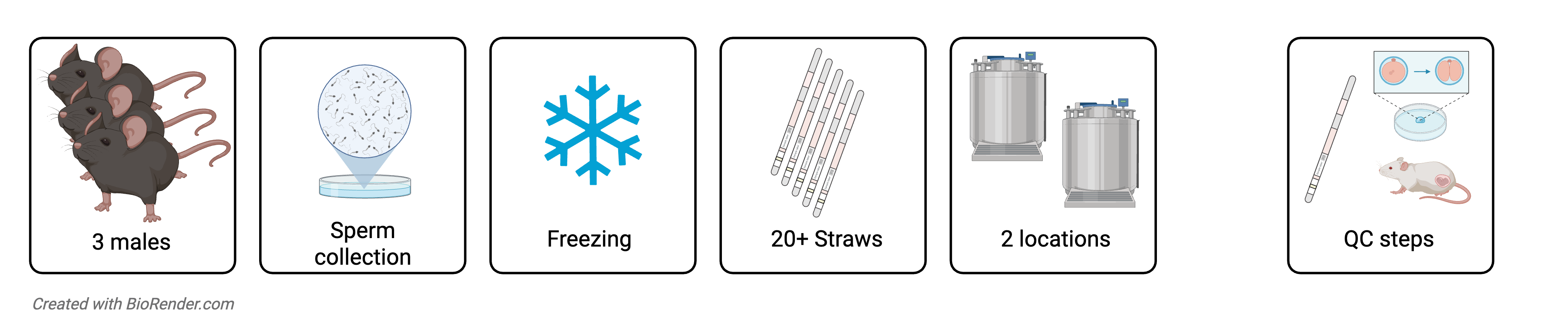
Description: Sperm is retrieved from the epididymal tissues of 3 male mice and is cryopreserved in 20 to 30 straws that are stored in liquid-phase, liquid nitrogen across two tanks in two separate locations (SRD and CCDD), to ensure sample safety and mitigate risks associated to unexpected or uncontrollable events.

Material needed: 3 males, reproductively active, 12-25 weeks old

Timeline: 2-6 weeks (dependant on QC method of choice)

Considerations: this method of cryopreservation is rapid and cheap; however, it only preserves half of the genome. This method is only recommended for single mutations on a common inbred background.

Quality Control: we provide different levels of Quality Control (QC) for different price ranges.

  1. Test thaw QC: we will thaw 1 straw the day after cryopreservation and visually assess motility and viability of the recovered sperm
  2. IVF and culture to blastocyst QC: we highly recommend this QC step. In addition to test thaw, we will also perform IVF and culture embryos up to blastocyst stage. We will provide the investigator with a fertility rate (%) for the recovered sperm. We will charge an extra cost to cover the IVF procedure.
  3. IVF and embryo transfer QC: In addition to test thaw, we will perform IVF and transfer 2-cell embryos into up to 3 pseudopregnant females to generate viable embryos/live pups. We will charge an extra cost to cover the IVF and embryo transfer procedures.

    Please note that we require you to provide your genotyping protocol, as well as full detail of the genetic content of each strain that you submit for cryopreservation.

Diagram of Sperm Cryopreservation

Embryo Cryopreservation:

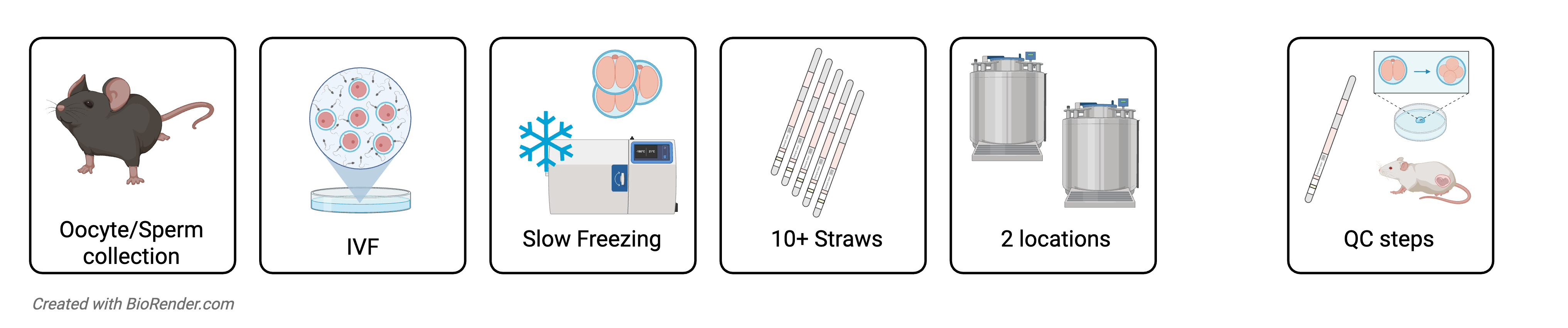
Description: Female mice are hormonally superovulated and oocytes are retrieved for in vitro fertilisation (IVF) with sperm from donor male. Resulting embryos are placed in cryoprotectant and loaded into multiple straws, which are gradually cooled and stored in liquid-phase liquid nitrogen in two separate tanks.

Material needed: Donor male and 8-10 donor females

Timeline: 12-15 weeks

Diagram of Embryo Cryopreservation

Embryonic Stem Cells Cryopreservation:

Not available, yet.

Oocyte Cryopreservation:

Not available, yet.

Cryostorage:

If you have cryopreserved mouse sperm/embryo/oocytes at another institution, we can cryostorage your samples for an annual fee. We do require that the investigator takes charge of shipping costs into our facility, and that thawing and genotyping protocols are submitted to the CIVM.

The CIVM stores all samples in liquid-phase liquid nitrogen tanks (CryoPlus1, ThermoFisher Scientific). Material retrieved from each strain is split between 2 tanks, a main and a backup tank, for redundancy. For additional safety, these 2 tanks are located in two separate buildings at ICR Sutton. Both tanks are continuously monitored by T-scan alarm systems and undergo annual service, as well as daily visual inspections.


Sperm Cryorecovery:

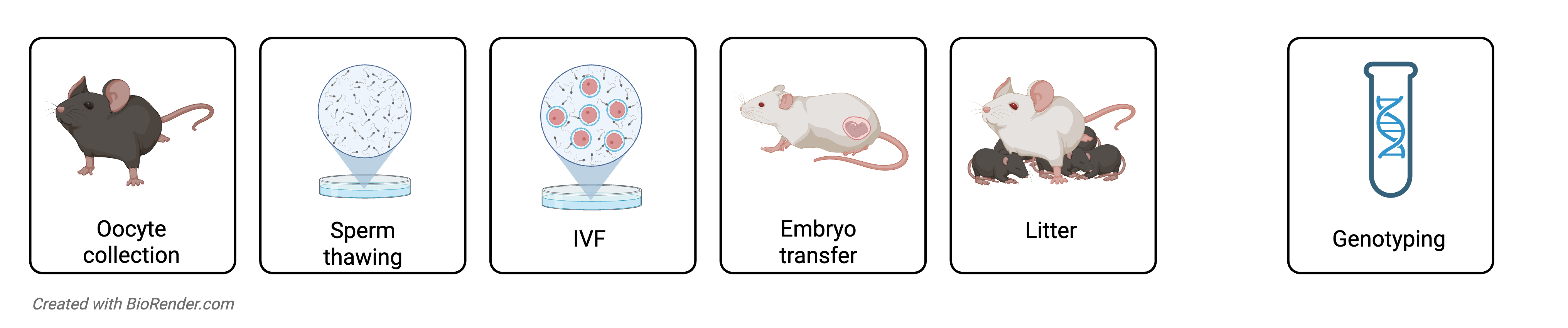
Description: Frozen sperm is cryorecovered by IVF, followed by embryo transfer. We can purchase wild-type female oocyte donors of the same genetic background, or alternatively the investigator can provide homozygous oocyte donors of the same strain.

Material needed: straw with frozen sperm and 8 to 12 females for IVF, 7-16 weeks old.

Timeline: 12-15 weeks

Diagram of Sperm Cryorecovery


Embryo Cryorecovery:

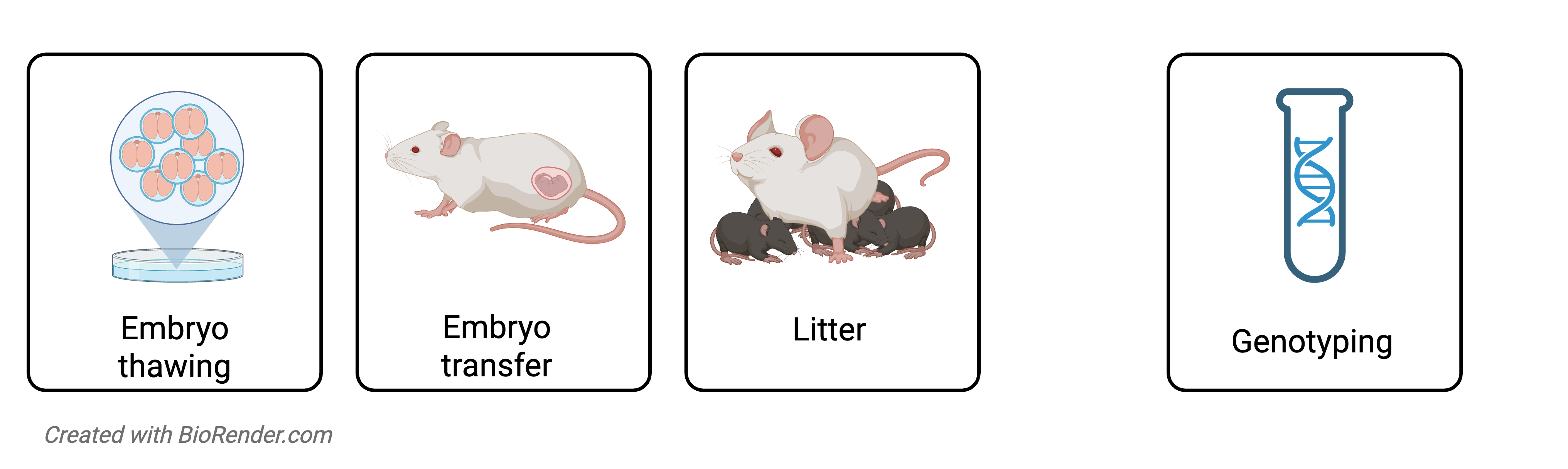
Description: Frozen 2-cell embryos are thawed and transferred into pseudopregnant females.

Material needed: straw(s) with frozen 2-cell embryos

Timeline: 8-10 week


Oocyte Cryorecovery:

Not available, yet.


Mouse rederivation

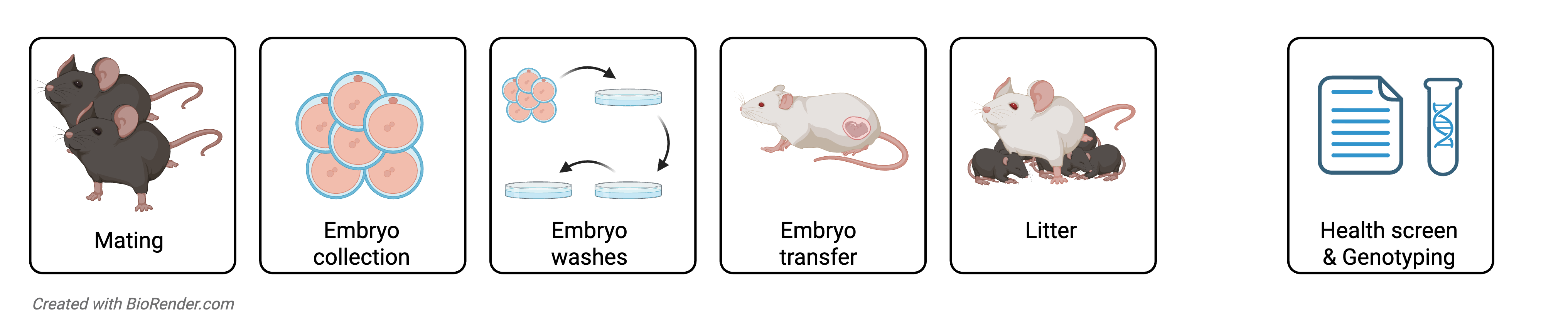
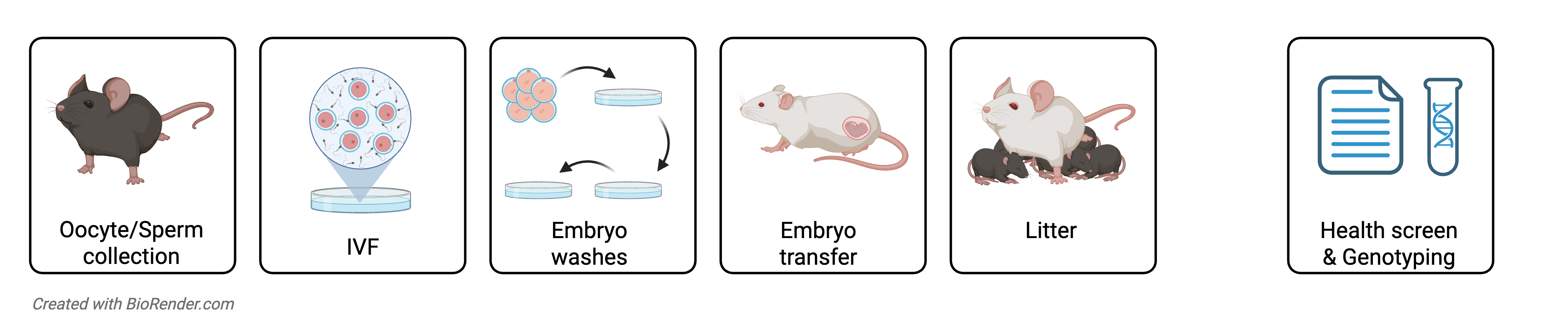
Description: Mouse rederivation is a process used to produce pathogen-free mouse colonies by removing microbial contaminants from existing lines. The procedure can be performed either through natural mating or in vitro fertilization (IVF):

  • In natural mating, embryos are obtained from donor mice and transferred into pathogen-free recipient females.
  • In IVF-based rederivation, fertilized embryos are created in vitro using gametes from donor mice and then implanted into clean recipient females.

Both methods effectively eliminate pathogens, allowing safe importation of mouse strains from lower health-status facilities into the ICR BSU. Samples from both litter and recipient mother will be sent for Health Screening and the associated costs will be charged separately to the Investigator.

Material needed: For IVF-based rederivation we require the investigator to provide 2 males, reproductively active, 12-25 weeks old, and the CIVM will purchase wild-type female egg-donors. Alternatively, if maintaining homozygosity is essential, the investigator will need to provide additional 6-10 females, 7-16 weeks old.

Timeline: 12-15 week

Mouse Rederivation Mating Diagram

Mouse Rederivation IVF diagram

We are currently setting up CRISPR/Cas9-based gene editing protocols. Soon, you’ll be able to apply for projects that involve developing new alleles based on:

  • Knockout by indel formation
  • Knockout by precise deletion
  • Conditional knockout
  • Knock-in of point mutations
  • Knock-in of small tags
  • Large knock-in
  • Exon replacement

These alleles will be developed based on Electroporation of Microinjection of CRISPR/Cas9 system reagents.

We will collaborate with you to design the best strategy and help you generate the genetically engineered mice you need for your project. 

We also provide:

  • Development of humanised mouse strains
  • Development of Patient-derived xenografts (PDX) and organoid models

Latest ICR News

28/01/26

The Institute of Cancer Research, London, is the joint recipient of a major new Medical Research Council (MRC) grant to advance how sensitive medical imaging data can be used for research.

An award of nearly £400,000 will fund the Federated Infrastructure for digital pathology Reporting and Expert Data Annotation in a Secure Environment (FIREDANSE) project, run in collaboration with The Royal Marsden NHS Foundation and Imperial College. FIREDANSE will form part of the newly announced portfolio of Data and Analytics Research Environments UK (DARE UK) Phase 2 catalysts, funded through UK Research and Innovation (UKRI).

This award sits within a wider £2.5 million investment across eight pioneering projects, which will run for 12 months and are intended to test bold, early‑stage ideas that could shape the future of UK data research infrastructure. The programme will push the boundaries of technology in the next generation of Trusted Research Environments (TREs) – highly secure digital platforms that allow approved researchers to access sensitive data safely and responsibly.  

Linking digital pathology data across Trusts

While today’s secure environments protect privacy and maintain public trust, they can limit the data types, tools and computational power available to researchers. The newly funded projects aim to explore how these restrictions might be safely overcome, opening the door to research questions that are currently difficult, or even impossible, to answer. The outputs will include prototypes, evidence and practical guidance to inform national policy and long‑term infrastructure planning.

FIREDANSE is led by Professor Manuel Salto-Tellez, Professor of Integrative Pathology, and Dr Simon Doran, Senior Staff Scientist in the Division of Radiotherapy and Imaging, both at The Institute of Cancer Research (ICR). Together with their co-investigators and collaborators, they will demonstrate the feasibility of securely linking biopsy images and associated clinical data across the TREs of two major cancer centres: The Royal Marsden’s BRIDgE TRE and the NIHR Imperial Biomedical Research Centre funded iCARE secure data environment.

By enabling these data connections across institutions, the team plans to show how future researchers could train more powerful artificial intelligence (AI) models to improve cancer diagnosis and treatment. The linked datasets will allow algorithms to learn from a greater variety of patient cases, making them more accurate and clinically useful. Such advances may ultimately help alleviate the severe workforce pressures facing pathology services both in the UK and internationally.

Expert review to address patient concerns about AI

A core element of the FIREDANSE project focuses on responding to patient and public concerns about the reliability of medical AI systems. People want to know that any AI used in healthcare is closely overseen and validated by hospital consultants throughout both development and deployment. They also want reassurance that there is no significant risk of algorithms generating inaccurate or misleading results.

To address this, the team will adapt an existing web‑based app developed at the ICR that allows consultants to view anonymised pathology images and clinical data securely, and to enter expert reviews in a structured and efficient way. The upgraded platform will work seamlessly across both The Royal Marsden and Imperial, enabling multi‑hospital expert validation of AI models. This will support not only algorithm development but also ongoing quality assurance, ensuring that AI tools perform consistently and safely in clinical settings.

Public engagement and governance

Public involvement is central to the project. FIREDANSE will run engagement activities to better understand public priorities and concerns, introduce participants to the language and concepts of AI in healthcare, and facilitate discussions among citizens, clinicians and data scientists. The aim is to help build trust while demystifying the complexities involved in securely protecting sensitive data within institutional boundaries, even as researchers collaborate across sites.

The team will present its engagement materials to information governance professionals at partner organisations. Their approval will be required for the test system to be used more widely, offering an early indication of whether the project’s communication approach meets the needs of both experts and non‑specialists.

Building the future of secure data research

Announcing the funding, Emily Jefferson, Interim Director of DARE UK, said:

“These projects are intentionally exploratory. They give researchers the freedom to test bold ideas that challenge current assumptions about how Trusted Research Environments work. By investing in early‑stage prototypes and strong public engagement, we are building the evidence needed to shape future infrastructure that is secure, flexible and worthy of public trust.”

The findings from FIREDANSE and the other funded projects will be shared widely across the research community. The aim is to guide the future direction of DARE UK and shape national and sector‑wide approaches to securing data research, helping ensure that the UK remains a global leader in the safe, responsible and innovative use of sensitive health data.

Dr Simon Doran, Senior Staff Scientist in the Division of Radiotherapy and Imaging, at The Institute of Cancer Research, London said:

“It’s a huge honour to receive this award, and we are immensely grateful to the MRC for continuing to fund research that has a real-world impact.

“Our project’s name, inspired by the Balinese fire dance, symbolises the careful choreography required to move sensitive data safely between secure environments – a balancing act of jeopardy, precision, coordination and technical mastery. In the same spirit, we aim to demonstrate how cutting‑edge data infrastructure can support better research while protecting the privacy and trust of the patients at its heart.”

Erik Mayer, Clinical Associate Professor and Director of the iCARE Secure Data Environment at Imperial, said:

“We are very grateful to DARE UK for funding this work that will help us continue to develop a fully interoperable national network of secure data research infrastructures for public and patient benefit.”

Steven Francis, Chief Information Officer at The Royal Marsden NHS Foundation Trust, said: 

“Allowing access to data for collaborative research projects, whilst retaining complete control of anonymised patient data, is a major challenge for the world's leading healthcare institutions. We are very grateful to DARE UK for funding this work, as FIREDANSE will create new technology to ensure the UK remains at the forefront of this field whilst reassuring the public that their data is being used responsibly.”

Image credit: Brian Penny from Pixabay