
Centre for In Vivo Modelling Service Core

At the Centre for In Vivo Modelling (CIVM), we combine advanced animal genetics and cutting-edge technologies to drive cancer research. Our multidisciplinary team specialises in the generation and maintenance of genetically engineered mouse models (GEMMs), humanised mouse strains, and patient-derived models (xenografts and organoids), using innovations such as CRISPR gene editing, embryo manipulation, and in vivo genetic screening. We develop and cryopreserve new cancer models that closely replicate human disease, supporting translational studies that inform effective therapies. Our approach integrates rigorous scientific standards, ethical oversight, and collaborative expertise, aiming to accelerate progress in understanding cancer biology and developing better treatments for patients.

Our Centre is dedicated to driving innovation and excellence in cancer research through advanced in vivo modelling. We work in close collaboration with the ICR researchers and clinicians at The Royal Marsden to generate genetically engineered mouse models (GEMMs) and patient-derived models, such as patient-derived xenografts (PDXs) and patient-derived organoids (PDOs) to interrogate cancer biology in its own ecosystem. By leveraging these sophisticated in vivo systems, the Centre aims to:

  • Develop innovative cancer models in collaboration with ICR researchers to advance cancer research and drug discovery.
  • Work in partnership with The Royal Marsden Hospital to obtain patient samples and generate new patient-derived cancer models for translational studies.
  • Foster close interdisciplinary collaboration with drug discovery teams to leverage these in vivo models in the creation and testing of next-generation anti-cancer therapies.
  • Continuously improve the sophistication and relevance of our cancer models, ensuring they more faithfully recapitulate the complexity of human disease and enhance the translational impact of our research.


Our services

Advantages of cryopreserving your strains:

  • Allows you to save space, by getting the mice you need, when you need;
  • Reduces your animal costs;
  • Reduces animal use;
  • Reduces risk from disasters (e.g. disease outbreaks, breeding cessation, equipment failures, genetic contamination, natural disasters, etc…).

 What can be cryopreserved?

  • Mouse Sperm
  • Mouse Embryos
  • Mouse Embryonic Stem Cells
  • Mouse Oocytes

 Sperm Cryopreservation:

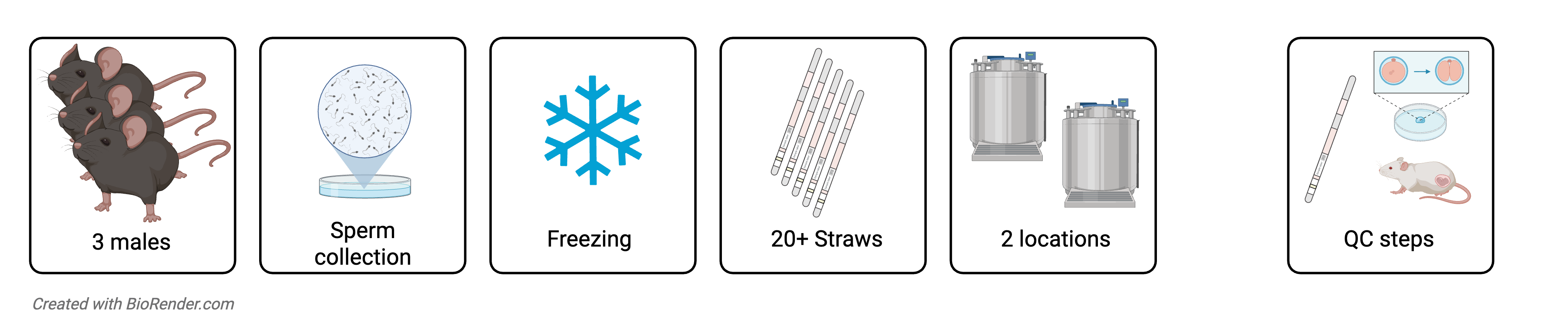
Description: Sperm is retrieved from the epididymal tissues of 3 male mice and is cryopreserved in 20 to 30 straws that are stored in liquid-phase, liquid nitrogen across two tanks in two separate locations (SRD and CCDD), to ensure sample safety and mitigate risks associated to unexpected or uncontrollable events.

Material needed: 3 males, reproductively active, 12-25 weeks old

Timeline: 2-6 weeks (dependant on QC method of choice)

Considerations: this method of cryopreservation is rapid and cheap; however, it only preserves half of the genome. This method is only recommended for single mutations on a common inbred background.

Quality Control: we provide different levels of Quality Control (QC) for different price ranges.

  1. Test thaw QC: we will thaw 1 straw the day after cryopreservation and visually assess motility and viability of the recovered sperm
  2. IVF and culture to blastocyst QC: we highly recommend this QC step. In addition to test thaw, we will also perform IVF and culture embryos up to blastocyst stage. We will provide the investigator with a fertility rate (%) for the recovered sperm. We will charge an extra cost to cover the IVF procedure.
  3. IVF and embryo transfer QC: In addition to test thaw, we will perform IVF and transfer 2-cell embryos into up to 3 pseudopregnant females to generate viable embryos/live pups. We will charge an extra cost to cover the IVF and embryo transfer procedures.

    Please note that we require you to provide your genotyping protocol, as well as full detail of the genetic content of each strain that you submit for cryopreservation.

Diagram of Sperm Cryopreservation

Embryo Cryopreservation:

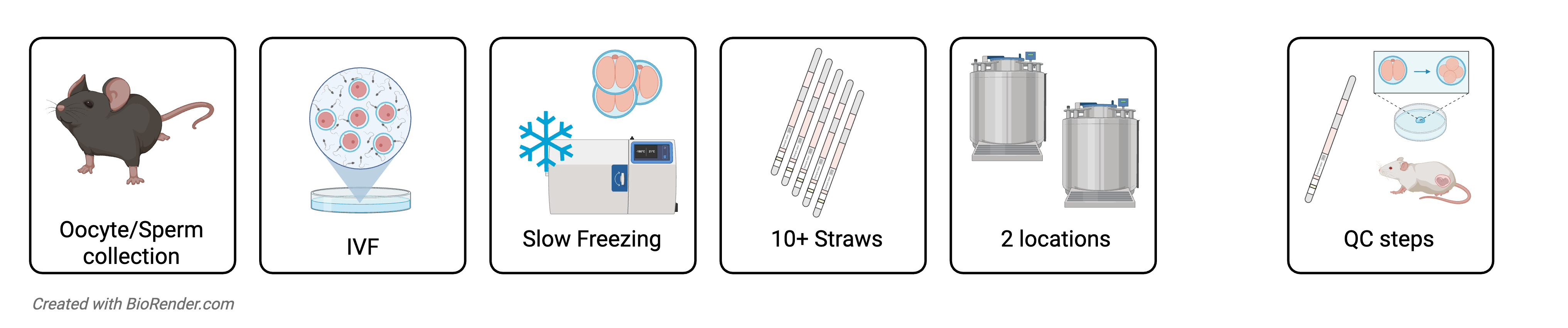
Description: Female mice are hormonally superovulated and oocytes are retrieved for in vitro fertilisation (IVF) with sperm from donor male. Resulting embryos are placed in cryoprotectant and loaded into multiple straws, which are gradually cooled and stored in liquid-phase liquid nitrogen in two separate tanks.

Material needed: Donor male and 8-10 donor females

Timeline: 12-15 weeks

Diagram of Embryo Cryopreservation

Embryonic Stem Cells Cryopreservation:

Not available, yet.

Oocyte Cryopreservation:

Not available, yet.

Cryostorage:

If you have cryopreserved mouse sperm/embryo/oocytes at another institution, we can cryostorage your samples for an annual fee. We do require that the investigator takes charge of shipping costs into our facility, and that thawing and genotyping protocols are submitted to the CIVM.

The CIVM stores all samples in liquid-phase liquid nitrogen tanks (CryoPlus1, ThermoFisher Scientific). Material retrieved from each strain is split between 2 tanks, a main and a backup tank, for redundancy. For additional safety, these 2 tanks are located in two separate buildings at ICR Sutton. Both tanks are continuously monitored by T-scan alarm systems and undergo annual service, as well as daily visual inspections.


Sperm Cryorecovery:

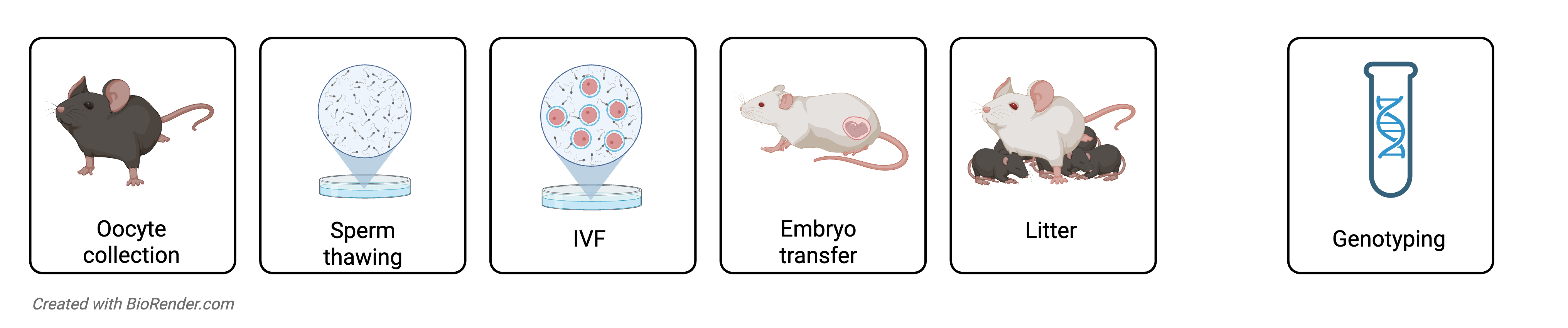
Description: Frozen sperm is cryorecovered by IVF, followed by embryo transfer. We can purchase wild-type female oocyte donors of the same genetic background, or alternatively the investigator can provide homozygous oocyte donors of the same strain.

Material needed: straw with frozen sperm and 8 to 12 females for IVF, 7-16 weeks old.

Timeline: 12-15 weeks

Diagram of Sperm Cryorecovery


Embryo Cryorecovery:

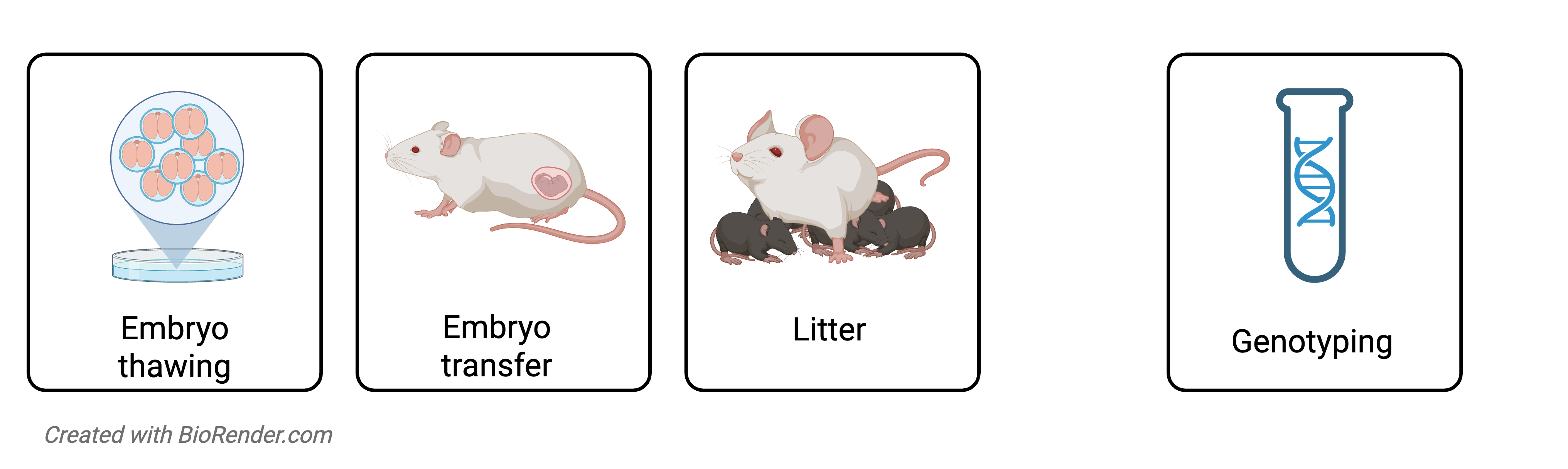
Description: Frozen 2-cell embryos are thawed and transferred into pseudopregnant females.

Material needed: straw(s) with frozen 2-cell embryos

Timeline: 8-10 week


Oocyte Cryorecovery:

Not available, yet.


Mouse rederivation

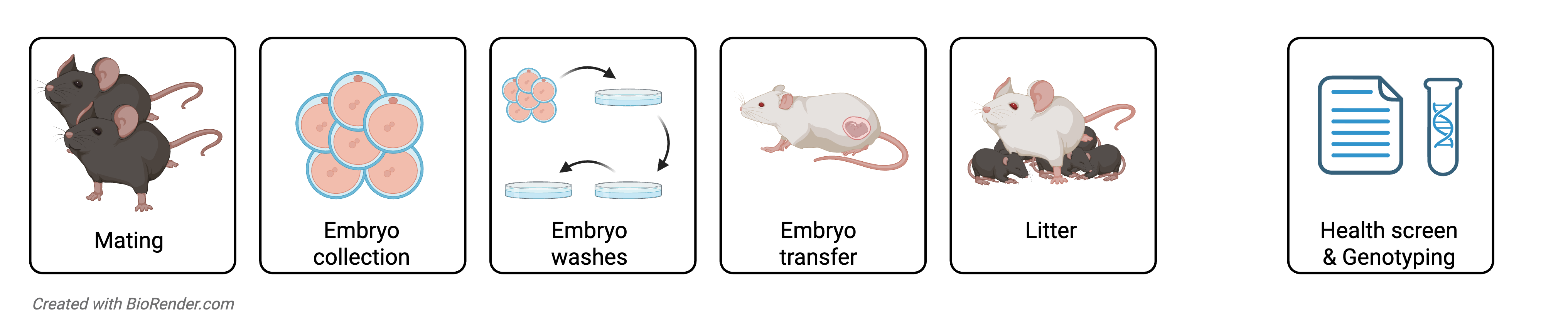
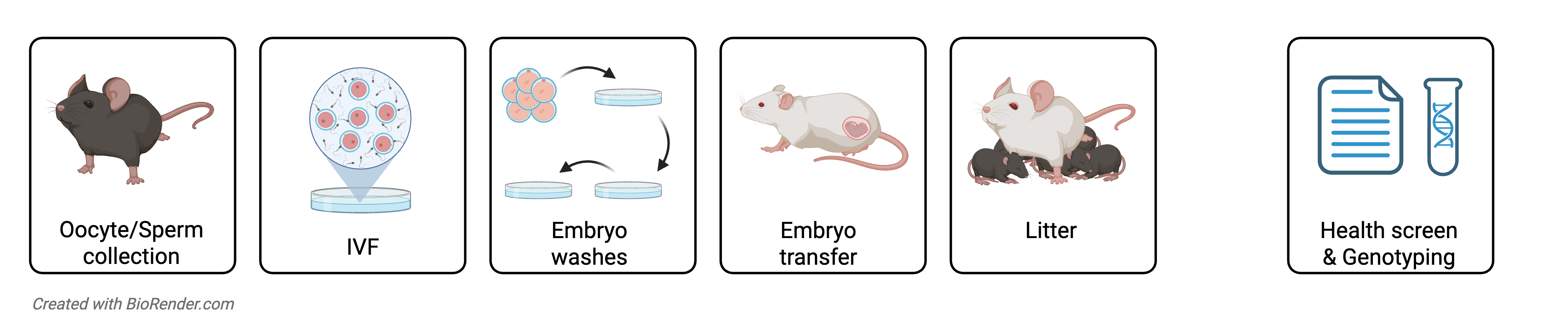
Description: Mouse rederivation is a process used to produce pathogen-free mouse colonies by removing microbial contaminants from existing lines. The procedure can be performed either through natural mating or in vitro fertilization (IVF):

  • In natural mating, embryos are obtained from donor mice and transferred into pathogen-free recipient females.
  • In IVF-based rederivation, fertilized embryos are created in vitro using gametes from donor mice and then implanted into clean recipient females.

Both methods effectively eliminate pathogens, allowing safe importation of mouse strains from lower health-status facilities into the ICR BSU. Samples from both litter and recipient mother will be sent for Health Screening and the associated costs will be charged separately to the Investigator.

Material needed: For IVF-based rederivation we require the investigator to provide 2 males, reproductively active, 12-25 weeks old, and the CIVM will purchase wild-type female egg-donors. Alternatively, if maintaining homozygosity is essential, the investigator will need to provide additional 6-10 females, 7-16 weeks old.

Timeline: 12-15 week

Mouse Rederivation Mating Diagram

Mouse Rederivation IVF diagram

We are currently setting up CRISPR/Cas9-based gene editing protocols. Soon, you’ll be able to apply for projects that involve developing new alleles based on:

  • Knockout by indel formation
  • Knockout by precise deletion
  • Conditional knockout
  • Knock-in of point mutations
  • Knock-in of small tags
  • Large knock-in
  • Exon replacement

These alleles will be developed based on Electroporation of Microinjection of CRISPR/Cas9 system reagents.

We will collaborate with you to design the best strategy and help you generate the genetically engineered mice you need for your project. 

We also provide:

  • Development of humanised mouse strains
  • Development of Patient-derived xenografts (PDX) and organoid models

Latest ICR News

13/05/26

Scientists have uncovered a previously hidden role for a protein frequently mutated in cancer, showing that it helps maintain the stability of the genome at some of its most vulnerable sites.

The study sheds light on why the loss of this protein, called SMARCA4, can leave cells prone to accumulating genetic damage, which is associated with the development and progression of cancer.

By combining several cutting‑edge genomic approaches, the researchers were able to pinpoint not just where damage occurs, but also how the surrounding chromatin environment contributes to vulnerability or protection. Importantly, the findings indicate that it might one day be possible to exploit this weakness to treat cancer.

The study was led by scientists at The Institute of Cancer Research, London, and the findings were published in the journal Genome Biology. Funding for the work came from multiple sources, including the Medical Research Council, Cancer Research UK and The Institute of Cancer Research (ICR), which is both a research institute and a charity.

A key role for SMARCA4

SMARCA4 is a core component of a large protein complex known as SWI/SNF. This molecular machine helps organise DNA inside the cell nucleus so that genes can be switched on and off at the right time.

Mutations in SWI/SNF components are found in about one in five cancers, with SMARCA4 altered in close to 11 per cent of those cases. Despite this prominence, many of SMARCA4’s functions have not yet been uncovered. The new study adds an important piece to the puzzle by showing that SMARCA4 acts as a genomic ‘caretaker’ at unusual DNA structures known as G‑quadruplexes.

Although DNA is typically presented as a simple double helix, it can fold into a variety of shapes. Among these is the G‑quadruplex, or G4, which is a four‑stranded structure rich in guanine – one of the main four building blocks in DNA. These structures are common in the human genome and are often found in places where gene activity needs to be carefully regulated.

G‑quadruplexes can be useful. They can act as signposts, helping to control gene expression or recruit proteins needed for DNA replication and repair. However, they can also be hazardous. If a G‑quadruplex forms at the wrong time or persists for too long, it can block the cellular machinery that copies DNA, increasing the risk of breaks or mutations.

The researchers discovered that SMARCA4 has a crucial role in limiting these errors. By studying human cells lacking SMARCA4, they found striking increases in two hallmarks of genome instability at predicted G‑quadruplex sites: DNA double‑strand breaks and small sequence changes known as single‑nucleotide variants.

A pattern also seen in patients

What makes the findings particularly compelling is that the same pattern appears not only in laboratory cell models but also in tissue samples from cancer patients. Tumours carrying SMARCA4 mutations showed a higher proportion of mutations within G‑quadruplex sequences themselves, rather than merely nearby. This suggests that the absence of SMARCA4 leaves these regions of the genome particularly exposed.

In addition, the team found that the proportion of mutations at G‑quadruplexes in SMARCA4‑mutant cancers was even greater than that seen in tumours with mutations in TP53, a gene long known as the ‘guardian of the genome’. This comparison highlights just how important SMARCA4 may be in protecting DNA integrity at these important sites.

Turning a weakness into an opportunity

The study also explored how SMARCA4‑deficient cells respond to drugs that stabilise G‑quadruplexes. One such compound, called pyridostatin, locks G‑quadruplex structures in place. In cells already lacking SMARCA4’s protective influence, this proved especially harmful.

When treated with pyridostatin, SMARCA4‑deficient cells struggled to recruit important DNA repair factors after replication. The researchers observed signs of increased single‑stranded DNA gaps – another indicator of replication stress and genomic instability. Together, these findings hint at why cancers with SMARCA4 mutations might be particularly sensitive to therapies that target G‑quadruplexes.

This has clear clinical implications. Several G‑quadruplex‑stabilising drugs are already being tested in early‑stage clinical trials. If further research confirms these results, patients whose tumours carry SMARCA4 mutations could be prime candidates for such treatments, either alone or in combination with other therapies.

Globally, the potential reach is significant. Based on current cancer statistics, hundreds of thousands of people worldwide each year may develop cancers with SMARCA4 mutations. The benefit could extend even further, as defects in other SWI/SNF subunits have also been linked to sensitivity to G‑quadruplex‑targeting drugs.

Opening new research paths

Beyond this therapeutic promise, the study raises wider questions about genome maintenance. SMARCA4 is only one part of the SWI/SNF complex, which contains multiple subunits with distinct roles. The research community must now determine whether and how other components of the complex help safeguard G‑quadruplexes.

For now, the immediate impact is a deeper understanding of how genome instability arises in certain cancers. In the longer term, the hope is that insights like these will help turn a fundamental weakness of cancer cells into a therapeutic advantage.

First author Dr Alison Harrod, a Postdoctoral Training Fellow in the Epigenetics and Genome Stability Group at the ICR, said:

“G‑quadruplexes are a bit like knots in a rope. They can be helpful if they’re tied and untied at the right moments, but if they’re left in place, they tend to create stress and damage.

“We expected to see some vulnerability at G‑quadruplexes, but it was striking that the breaks and mutations were sitting right in the G4 sequences – and that this was so clear in the patient data, which is much more genetically complex than any cell line.”

Senior author Professor Jessica Downs, Deputy Head of the Cell and Molecular Biology Division at the ICR, said:

“SMARCA4 mutations are very common in cancer, yet the impact of these mutations in the initiation and progression of the disease remains incompletely understood. This study uncovered an important new role of SMARCA4, showing that a protein that organises packaging of DNA within the cell also acts as a protective factor at unusually folded DNA structures.

“The distinctive pattern of genetic changes we identified has the potential to significantly influence cancer progression in patients lacking SMARCA4 and helps us to understand the consequence of SMARCA4 loss in cancer more deeply.”

Image credit: congerdesign from Pixabay (modified)