

Centre for In Vivo Modelling Service Core

At the Centre for In Vivo Modelling (CIVM), we combine advanced animal genetics and cutting-edge technologies to drive cancer research. Our multidisciplinary team specialises in the generation and maintenance of genetically engineered mouse models (GEMMs), humanised mouse strains, and patient-derived models (xenografts and organoids), using innovations such as CRISPR gene editing, embryo manipulation, and in vivo genetic screening. We develop and cryopreserve new cancer models that closely replicate human disease, supporting translational studies that inform effective therapies. Our approach integrates rigorous scientific standards, ethical oversight, and collaborative expertise, aiming to accelerate progress in understanding cancer biology and developing better treatments for patients.

Our Centre is dedicated to driving innovation and excellence in cancer research through advanced in vivo modelling. We work in close collaboration with the ICR researchers and clinicians at The Royal Marsden to generate genetically engineered mouse models (GEMMs) and patient-derived models, such as patient-derived xenografts (PDXs) and patient-derived organoids (PDOs) to interrogate cancer biology in its own ecosystem. By leveraging these sophisticated in vivo systems, the Centre aims to:

  • Develop innovative cancer models in collaboration with ICR researchers to advance cancer research and drug discovery.
  • Work in partnership with The Royal Marsden Hospital to obtain patient samples and generate new patient-derived cancer models for translational studies.
  • Foster close interdisciplinary collaboration with drug discovery teams to leverage these in vivo models in the creation and testing of next-generation anti-cancer therapies.
  • Continuously improve the sophistication and relevance of our cancer models, ensuring they more faithfully recapitulate the complexity of human disease and enhance the translational impact of our research.


Our services

Advantages of cryopreserving your strains:

  • Allows you to save space, by getting the mice you need, when you need;
  • Reduces your animal costs;
  • Reduces animal use;
  • Reduces risk from disasters (e.g. disease outbreaks, breeding cessation, equipment failures, genetic contamination, natural disasters, etc…).

 What can be cryopreserved?

  • Mouse Sperm
  • Mouse Embryos
  • Mouse Embryonic Stem Cells
  • Mouse Oocytes

 Sperm Cryopreservation:

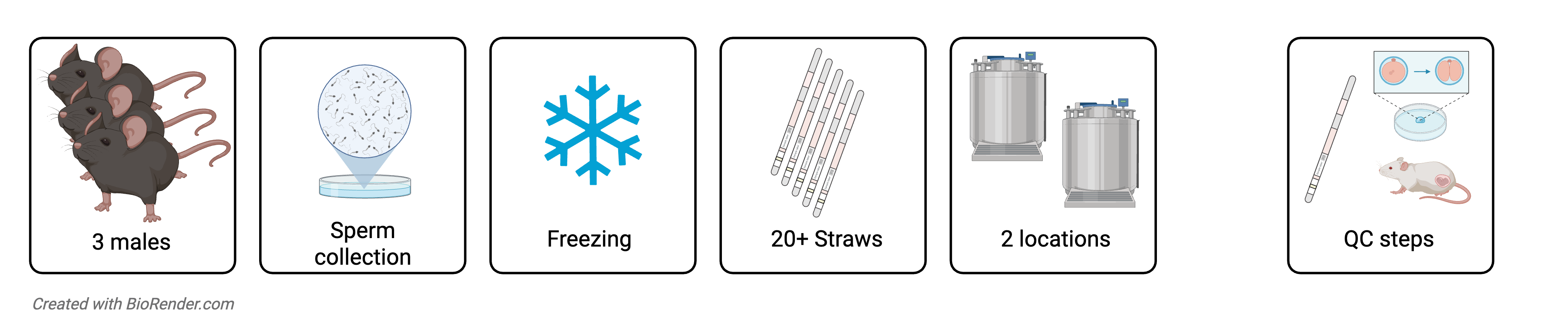
Description: Sperm is retrieved from the epididymal tissues of 3 male mice and is cryopreserved in 20 to 30 straws that are stored in liquid-phase, liquid nitrogen across two tanks in two separate locations (SRD and CCDD), to ensure sample safety and mitigate risks associated to unexpected or uncontrollable events.

Material needed: 3 males, reproductively active, 12-25 weeks old

Timeline: 2-6 weeks (dependant on QC method of choice)

Considerations: this method of cryopreservation is rapid and cheap; however, it only preserves half of the genome. This method is only recommended for single mutations on a common inbred background.

Quality Control: we provide different levels of Quality Control (QC) for different price ranges.

  1. Test thaw QC: we will thaw 1 straw the day after cryopreservation and visually assess motility and viability of the recovered sperm
  2. IVF and culture to blastocyst QC: we highly recommend this QC step. In addition to test thaw, we will also perform IVF and culture embryos up to blastocyst stage. We will provide the investigator with a fertility rate (%) for the recovered sperm. We will charge an extra cost to cover the IVF procedure.
  3. IVF and embryo transfer QC: In addition to test thaw, we will perform IVF and transfer 2-cell embryos into up to 3 pseudopregnant females to generate viable embryos/live pups. We will charge an extra cost to cover the IVF and embryo transfer procedures.

    Please note that we require you to provide your genotyping protocol, as well as full detail of the genetic content of each strain that you submit for cryopreservation.

Diagram of Sperm Cryopreservation

Embryo Cryopreservation:

Description: Female mice are hormonally superovulated and oocytes are retrieved for in vitro fertilisation (IVF) with sperm from donor male. Resulting embryos are placed in cryoprotectant and loaded into multiple straws, which are gradually cooled and stored in liquid-phase liquid nitrogen in two separate tanks.

Material needed: Donor male and 8-10 donor females

Timeline: 12-15 weeks

Diagram of Embryo Cryopreservation

Embryonic Stem Cells Cryopreservation:

Not available, yet.

Oocyte Cryopreservation:

Not available, yet.

Cryostorage:

If you have cryopreserved mouse sperm/embryo/oocytes at another institution, we can cryostorage your samples for an annual fee. We do require that the investigator takes charge of shipping costs into our facility, and that thawing and genotyping protocols are submitted to the CIVM.

The CIVM stores all samples in liquid-phase liquid nitrogen tanks (CryoPlus1, ThermoFisher Scientific). Material retrieved from each strain is split between 2 tanks, a main and a backup tank, for redundancy. For additional safety, these 2 tanks are located in two separate buildings at ICR Sutton. Both tanks are continuously monitored by T-scan alarm systems and undergo annual service, as well as daily visual inspections.


Sperm Cryorecovery:

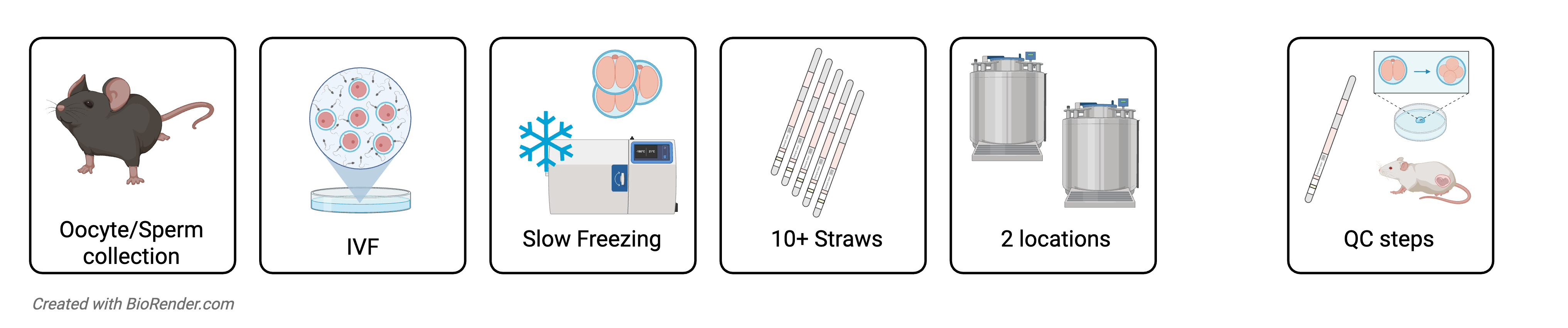
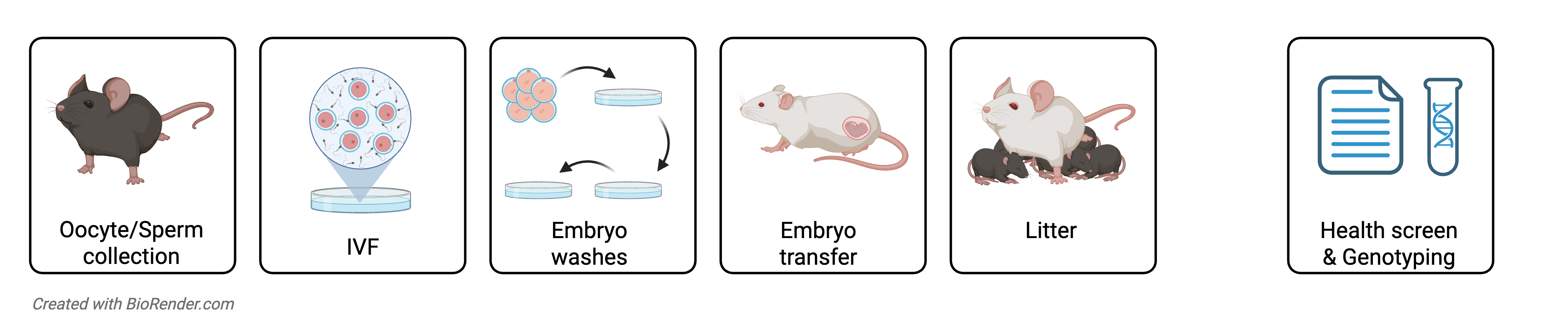
Description: Frozen sperm is cryorecovered by IVF, followed by embryo transfer. We can purchase wild-type female oocyte donors of the same genetic background, or alternatively the investigator can provide homozygous oocyte donors of the same strain.

Material needed: straw with frozen sperm and 8 to 12 females for IVF, 7-16 weeks old.

Timeline: 12-15 weeks

Diagram of Sperm Cryorecovery


Embryo Cryorecovery:

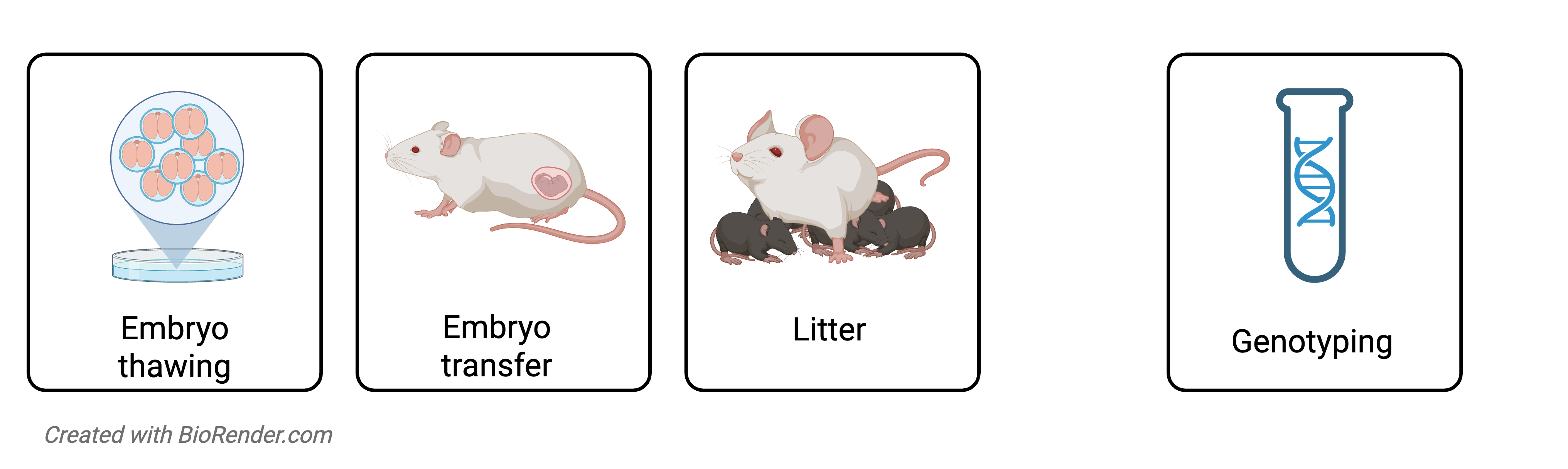
Description: Frozen 2-cell embryos are thawed and transferred into pseudopregnant females.

Material needed: straw(s) with frozen 2-cell embryos

Timeline: 8-10 week


Oocyte Cryorecovery:

Not available, yet.


Mouse rederivation

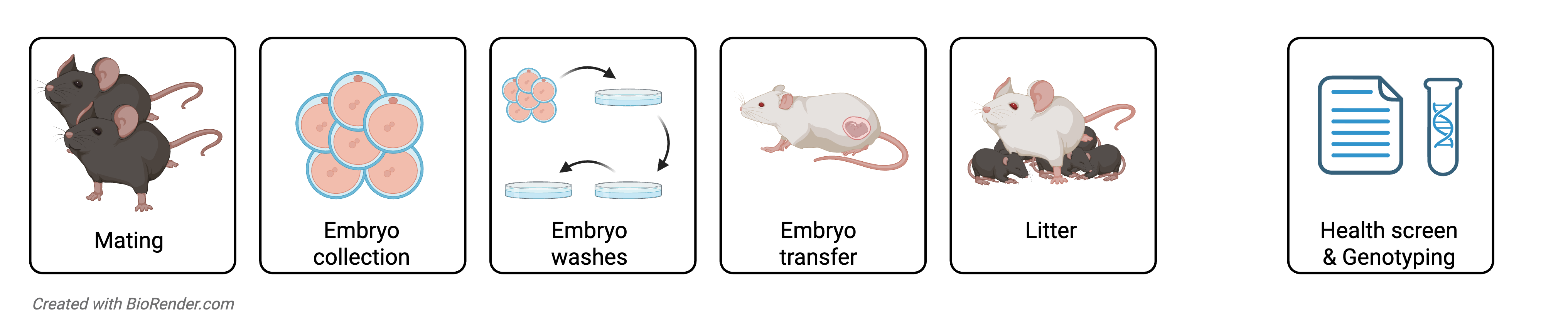
Description: Mouse rederivation is a process used to produce pathogen-free mouse colonies by removing microbial contaminants from existing lines. The procedure can be performed either through natural mating or in vitro fertilization (IVF):

  • In natural mating, embryos are obtained from donor mice and transferred into pathogen-free recipient females.
  • In IVF-based rederivation, fertilized embryos are created in vitro using gametes from donor mice and then implanted into clean recipient females.

Both methods effectively eliminate pathogens, allowing safe importation of mouse strains from lower health-status facilities into the ICR BSU. Samples from both litter and recipient mother will be sent for Health Screening and the associated costs will be charged separately to the Investigator.

Material needed: For IVF-based rederivation we require the investigator to provide 2 males, reproductively active, 12-25 weeks old, and the CIVM will purchase wild-type female egg-donors. Alternatively, if maintaining homozygosity is essential, the investigator will need to provide additional 6-10 females, 7-16 weeks old.

Timeline: 12-15 week

Mouse Rederivation Mating Diagram

Mouse Rederivation IVF diagram

We are currently setting up CRISPR/Cas9-based gene editing protocols. Soon, you’ll be able to apply for projects that involve developing new alleles based on:

  • Knockout by indel formation
  • Knockout by precise deletion
  • Conditional knockout
  • Knock-in of point mutations
  • Knock-in of small tags
  • Large knock-in
  • Exon replacement

These alleles will be developed based on Electroporation of Microinjection of CRISPR/Cas9 system reagents.

We will collaborate with you to design the best strategy and help you generate the genetically engineered mice you need for your project. 

We also provide:

  • Development of humanised mouse strains
  • Development of Patient-derived xenografts (PDX) and organoid models

Latest ICR News

13/03/26


Scientists at The Institute of Cancer Research, London, are supporting an international clinical trial of a promising new immunotherapy treatment for advanced ovarian cancer.

Biotechnology firm Theolytics has been awarded €8 million research funding through the Horizon Europe programme, pending final negotiation, to support expansion of the OCTOPOD‑IV Phase IIa trial.

The trial will evaluate THEO‑260 – a next‑generation oncolytic immunotherapy designed to tackle the complex biology of stroma-rich carcinomas, starting with platinum‑resistant ovarian cancer.

As a partner in the programme, The Institute of Cancer Research (ICR) will lead key translational analyses, generating vital insights into how the treatment works in patients and identifying biomarkers that could guide future clinical development.

How the treatment works

THEO‑260 is a type of oncolytic immunotherapy, which uses a specially adapted virus that can infect and kill cancer cells while helping the immune system recognise and attack the tumour.

The therapy is designed to destroy both cancer cells and cancer‑associated fibroblasts – supportive cells inside the tumour that help it grow and protect it from the immune system. By breaking down these cells, the treatment may make tumours more vulnerable and easier for the immune system to target.

The ICR team, led by Professor Alan Melcher, will study tumour and blood samples from people taking part in the trial to understand what effect the treatment has inside the body and why it may benefit some patients more than others.

Addressing an unmet need

The programme brings together leading cancer centres from across the world and has been supported through major European research funding following a highly competitive selection process. Alongside the ICR, the collaboration includes the Cancer Center Clínica Universidad de Navarra in Spain, the Catalan Institute of Oncology in Spain, and Princess Margaret Hospital in Toronto, Canada.

Platinum‑resistant ovarian cancer is one of the most challenging forms of cancer to treat. Once chemotherapy stops working, treatment options are extremely limited and survival times are often short, so there is a pressing need for new therapies that work in different ways.

The OCTOPOD‑IV trial is the first time THEO‑260 is being tested in people. The study will explore whether the treatment is safe, how well patients tolerate it and whether it shows early signs of shrinking or controlling tumours. It will also collect detailed biological and immune information to support further development.

Recruitment is already underway in the UK and Spain, and more international sites will open as the trial expands. A second related study in the United States – looking at delivering the therapy directly into the abdomen – is also in progress.

Leading the way in immunotherapy

The ICR is internationally recognised for pioneering work on oncolytic viruses and innovative immunotherapy treatments. Professor Melcher’s group has shown how certain viruses can stimulate powerful immune responses against cancer, contributed to early clinical trials of new viral treatments, and helped establish the ICR’s Centre for Immunotherapy of Cancer to accelerate progress in the field.

Professor Alan Melcher, Professor of Translational Immunotherapy at The Institute of Cancer Research, London, said:

“The way this treatment works – attacking the tumour cells and the tumour’s supportive structure while activating the immune system at the same time – could offer a much‑needed new option for patients with advanced solid tumours.
“We are delighted to support the OCTOPOD‑IV study, and the ICR will provide key translational data to help understand this novel therapeutic approach and its potential for improving outcomes for patients.”

Dr Margaret Duffy, CSO and Co‑founder of Theolytics, said:

“Our collective success with this grant award reflects the extraordinary work being done by the team at Theolytics, and the calibre of our clinical and translational partner centres. The award validates both the scientific rationale behind our THEO‑260 programme and the huge potential of its novel oncolytic and ‘CAF‑lytic’ mechanism to address a significant unmet need in stroma-rich solid cancers. By integrating advanced translational analyses into our clinical trial design, we will clinically demonstrate the differentiated mechanism of action of THEO‑260 and provide key data to advance this programme and deliver true impact for cancer patients.”