
Centre for In Vivo Modelling Service Core

At the Centre for In Vivo Modelling (CIVM), we combine advanced animal genetics and cutting-edge technologies to drive cancer research. Our multidisciplinary team specialises in the generation and maintenance of genetically engineered mouse models (GEMMs), humanised mouse strains, and patient-derived models (xenografts and organoids), using innovations such as CRISPR gene editing, embryo manipulation, and in vivo genetic screening. We develop and cryopreserve new cancer models that closely replicate human disease, supporting translational studies that inform effective therapies. Our approach integrates rigorous scientific standards, ethical oversight, and collaborative expertise, aiming to accelerate progress in understanding cancer biology and developing better treatments for patients.

Our Centre is dedicated to driving innovation and excellence in cancer research through advanced in vivo modelling. We work in close collaboration with the ICR researchers and clinicians at The Royal Marsden to generate genetically engineered mouse models (GEMMs) and patient-derived models, such as patient-derived xenografts (PDXs) and patient-derived organoids (PDOs) to interrogate cancer biology in its own ecosystem. By leveraging these sophisticated in vivo systems, the Centre aims to:

  • Develop innovative cancer models in collaboration with ICR researchers to advance cancer research and drug discovery.
  • Work in partnership with The Royal Marsden Hospital to obtain patient samples and generate new patient-derived cancer models for translational studies.
  • Foster close interdisciplinary collaboration with drug discovery teams to leverage these in vivo models in the creation and testing of next-generation anti-cancer therapies.
  • Continuously improve the sophistication and relevance of our cancer models, ensuring they more faithfully recapitulate the complexity of human disease and enhance the translational impact of our research.


Our services

Advantages of cryopreserving your strains:

  • Allows you to save space, by getting the mice you need, when you need;
  • Reduces your animal costs;
  • Reduces animal use;
  • Reduces risk from disasters (e.g. disease outbreaks, breeding cessation, equipment failures, genetic contamination, natural disasters, etc…).

 What can be cryopreserved?

  • Mouse Sperm
  • Mouse Embryos
  • Mouse Embryonic Stem Cells
  • Mouse Oocytes

 Sperm Cryopreservation:

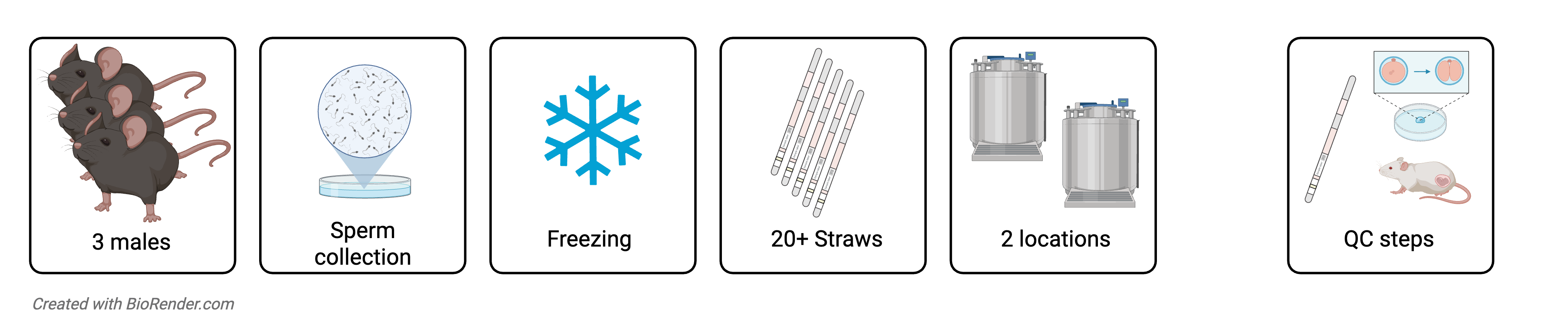
Description: Sperm is retrieved from the epididymal tissues of 3 male mice and is cryopreserved in 20 to 30 straws that are stored in liquid-phase, liquid nitrogen across two tanks in two separate locations (SRD and CCDD), to ensure sample safety and mitigate risks associated to unexpected or uncontrollable events.

Material needed: 3 males, reproductively active, 12-25 weeks old

Timeline: 2-6 weeks (dependant on QC method of choice)

Considerations: this method of cryopreservation is rapid and cheap; however, it only preserves half of the genome. This method is only recommended for single mutations on a common inbred background.

Quality Control: we provide different levels of Quality Control (QC) for different price ranges.

  1. Test thaw QC: we will thaw 1 straw the day after cryopreservation and visually assess motility and viability of the recovered sperm
  2. IVF and culture to blastocyst QC: we highly recommend this QC step. In addition to test thaw, we will also perform IVF and culture embryos up to blastocyst stage. We will provide the investigator with a fertility rate (%) for the recovered sperm. We will charge an extra cost to cover the IVF procedure.
  3. IVF and embryo transfer QC: In addition to test thaw, we will perform IVF and transfer 2-cell embryos into up to 3 pseudopregnant females to generate viable embryos/live pups. We will charge an extra cost to cover the IVF and embryo transfer procedures.

    Please note that we require you to provide your genotyping protocol, as well as full detail of the genetic content of each strain that you submit for cryopreservation.

Diagram of Sperm Cryopreservation

Embryo Cryopreservation:

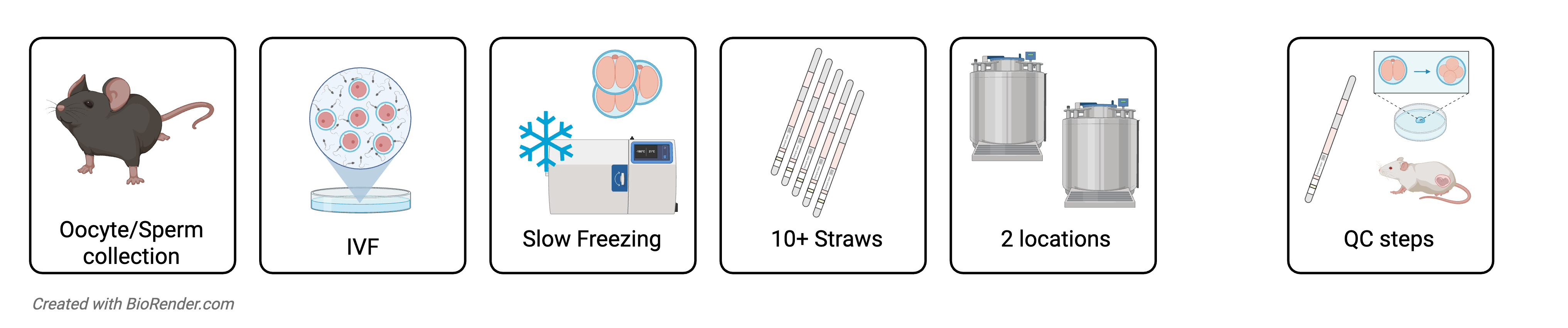
Description: Female mice are hormonally superovulated and oocytes are retrieved for in vitro fertilisation (IVF) with sperm from donor male. Resulting embryos are placed in cryoprotectant and loaded into multiple straws, which are gradually cooled and stored in liquid-phase liquid nitrogen in two separate tanks.

Material needed: Donor male and 8-10 donor females

Timeline: 12-15 weeks

Diagram of Embryo Cryopreservation

Embryonic Stem Cells Cryopreservation:

Not available, yet.

Oocyte Cryopreservation:

Not available, yet.

Cryostorage:

If you have cryopreserved mouse sperm/embryo/oocytes at another institution, we can cryostorage your samples for an annual fee. We do require that the investigator takes charge of shipping costs into our facility, and that thawing and genotyping protocols are submitted to the CIVM.

The CIVM stores all samples in liquid-phase liquid nitrogen tanks (CryoPlus1, ThermoFisher Scientific). Material retrieved from each strain is split between 2 tanks, a main and a backup tank, for redundancy. For additional safety, these 2 tanks are located in two separate buildings at ICR Sutton. Both tanks are continuously monitored by T-scan alarm systems and undergo annual service, as well as daily visual inspections.


Sperm Cryorecovery:

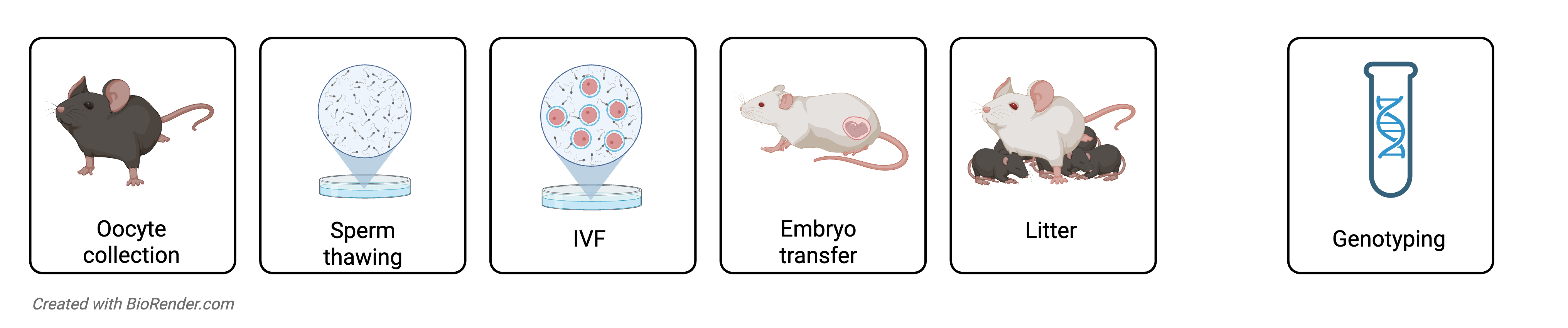
Description: Frozen sperm is cryorecovered by IVF, followed by embryo transfer. We can purchase wild-type female oocyte donors of the same genetic background, or alternatively the investigator can provide homozygous oocyte donors of the same strain.

Material needed: straw with frozen sperm and 8 to 12 females for IVF, 7-16 weeks old.

Timeline: 12-15 weeks

Diagram of Sperm Cryorecovery


Embryo Cryorecovery:

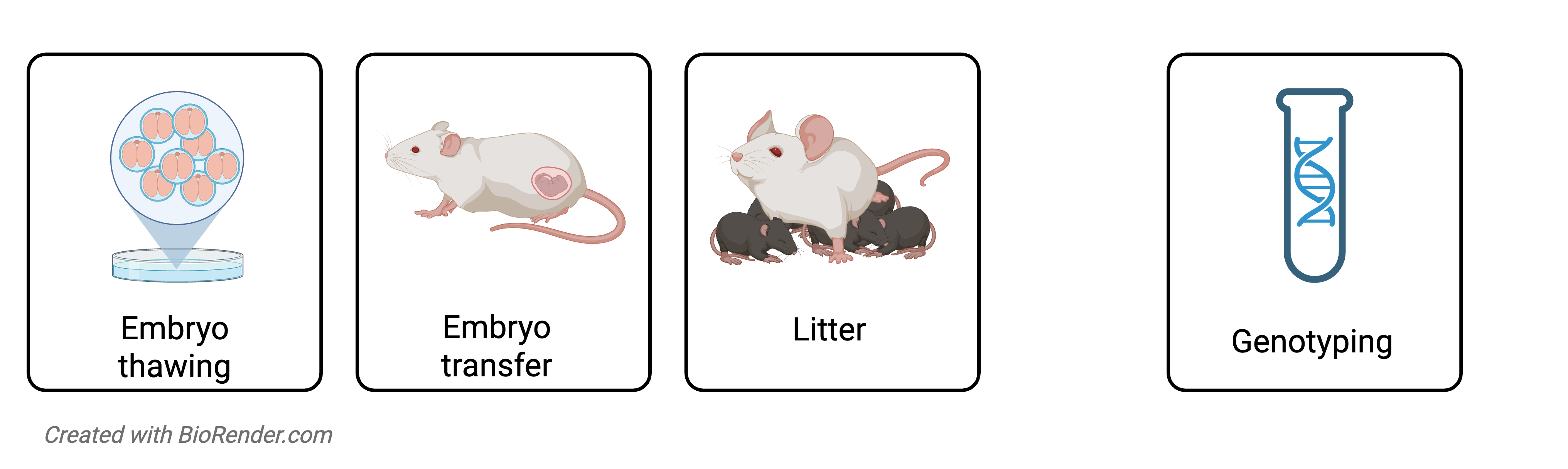
Description: Frozen 2-cell embryos are thawed and transferred into pseudopregnant females.

Material needed: straw(s) with frozen 2-cell embryos

Timeline: 8-10 week


Oocyte Cryorecovery:

Not available, yet.


Mouse rederivation

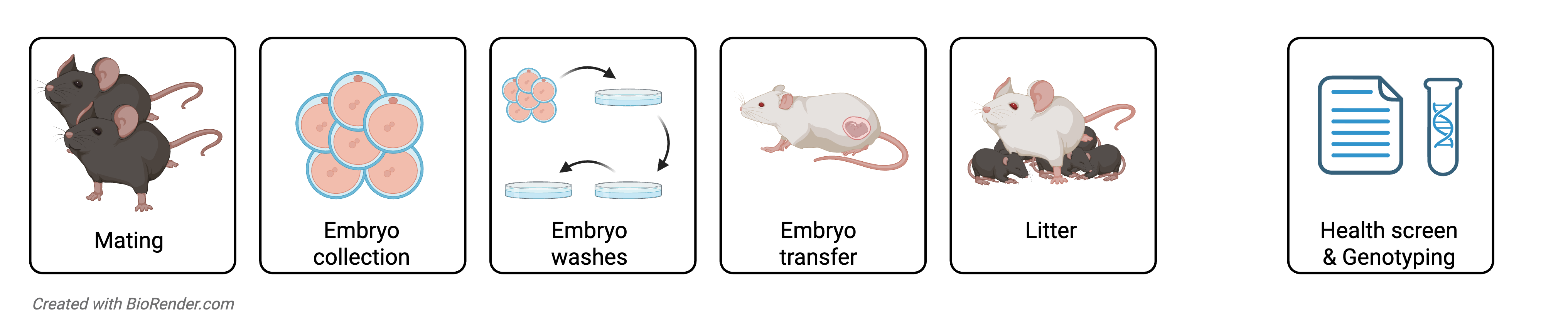
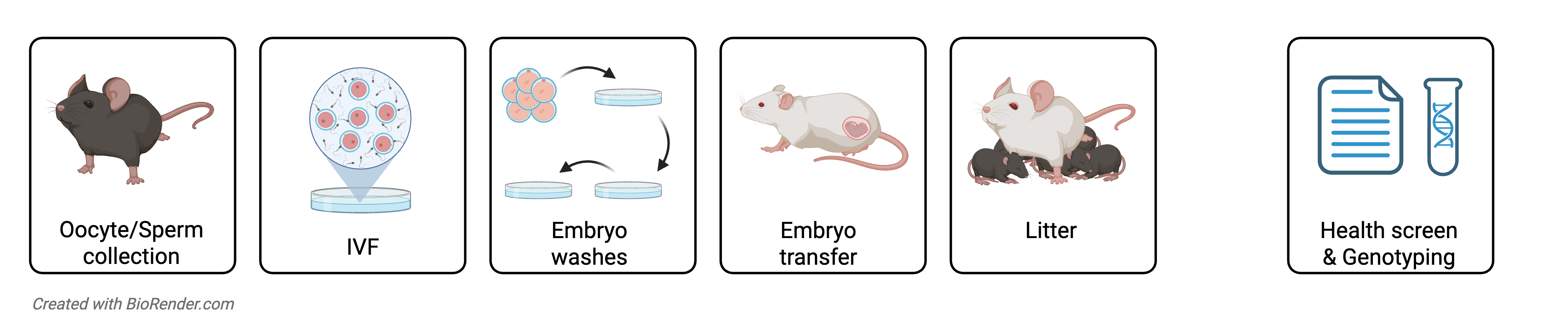
Description: Mouse rederivation is a process used to produce pathogen-free mouse colonies by removing microbial contaminants from existing lines. The procedure can be performed either through natural mating or in vitro fertilization (IVF):

  • In natural mating, embryos are obtained from donor mice and transferred into pathogen-free recipient females.
  • In IVF-based rederivation, fertilized embryos are created in vitro using gametes from donor mice and then implanted into clean recipient females.

Both methods effectively eliminate pathogens, allowing safe importation of mouse strains from lower health-status facilities into the ICR BSU. Samples from both litter and recipient mother will be sent for Health Screening and the associated costs will be charged separately to the Investigator.

Material needed: For IVF-based rederivation we require the investigator to provide 2 males, reproductively active, 12-25 weeks old, and the CIVM will purchase wild-type female egg-donors. Alternatively, if maintaining homozygosity is essential, the investigator will need to provide additional 6-10 females, 7-16 weeks old.

Timeline: 12-15 week

Mouse Rederivation Mating Diagram

Mouse Rederivation IVF diagram

We are currently setting up CRISPR/Cas9-based gene editing protocols. Soon, you’ll be able to apply for projects that involve developing new alleles based on:

  • Knockout by indel formation
  • Knockout by precise deletion
  • Conditional knockout
  • Knock-in of point mutations
  • Knock-in of small tags
  • Large knock-in
  • Exon replacement

These alleles will be developed based on Electroporation of Microinjection of CRISPR/Cas9 system reagents.

We will collaborate with you to design the best strategy and help you generate the genetically engineered mice you need for your project. 

We also provide:

  • Development of humanised mouse strains
  • Development of Patient-derived xenografts (PDX) and organoid models

Latest ICR News

09/03/26

Researchers have developed a new preclinical platform for studying aggressive childhood brain tumours, using advanced imaging to show how closely experimental models mirror the disease seen in patients.

Researchers at The Institute of Cancer Research, London, led work to develop a large panel of patient-derived mouse models of paediatric-type diffuse high-grade glioma (PDHGG) – a group of brain tumours with poor survival rates. Using magnetic resonance imaging (MRI), the research team demonstrated that these models reproduce key biological and radiological features of the human disease.

The study, published in Neuro-Oncology Advances and primarily funded by Cancer Research UK, provides a new framework for testing potential therapies and monitoring tumour response to closely reflect what happens in the clinic – helping researchers identify the most promising treatments for patients more quickly. Additional funding was received by CRIS Cancer Foundation and from a number of our family charity partners, including Abbie's Army, The Rudy A Menon Foundation, The Ollie Young Foundation, Lucas' Legacy and the Doing It For Daniel Foundation.

Building better models

PDHGGs, aggressive and fast-growing brain cancers, are among the leading causes of cancer-related morbidity and mortality in children and young adults. In most cases, median survival is only 9–18 months, with two- and five-year survival rates as low as 10 and two per cent, respectively.

Despite decades of research, outcomes have largely remained unchanged. This is primarily because these tumours are biologically distinct from other adult brain cancers with similar presentation, and they are difficult to model accurately in the laboratory.

To address this, the research team established 35 patient-derived, site-specific tumour models by implanting tumour material into the equivalent locations in the brains of mice. The models represent a range of PDHGG subtypes, including diffuse midline glioma (DMG) and diffuse hemispheric glioma (DHG).

Survival times varied widely across the models, reflecting the diversity seen in patients. While some tumours grew slowly over many months, others progressed more rapidly – an important feature to observe for testing new treatments.

Using MRI to understand tumour behaviour

Rather than relying solely on tissue analysis at the end of the experiment the researchers used non-invasive MRI to track tumour growth and behaviour over time. This approach allowed them to assess the size and structure of the tumour and the integrity of the blood-brain barrier – all vital factors in treatment response.

In the MRI images, the tumours varied in appearance, ranging from widespread growth to well-defined masses.

A key finding was that most tumours did not light up on MRI scans after a contrast agent was given, showing that the blood-brain barrier was still intact and blocking substances from entering the tumour – a major obstacle for drug delivery in patients. This was specifically true for tumours in the brainstem – the area connecting the brain to the spinal cord – mirroring clinical observations of being harder to treat and emphasising the importance of testing therapies in models that reflect this challenge.

The team also identified differences in water diffusion within tumours, using a technique called diffusion-weighted imaging, which generates images by mapping the random movement of water molecules in tissues. Brainstem tumours had higher apparent diffusion values than hemispheric tumours, a pattern also seen in patient scans, further confirming that the models closely reflect how these cancers behave in people.

Further examinations

The research team also examined whether tumours changed as they were re-implanted into new mice, a common step in maintaining experimental models. While some tumours grew faster when re-implanted, most retained the characteristics seen with MRI, suggesting that their fundamental biological features and appearance remained stable.

In a further set of experiments, tumours grown from cells cultured in three-dimensional conditions showed shorter survival and higher proliferation than those grown in traditional two-dimensional cultures. This demonstrates how laboratory growth conditions can influence behaviour and reinforces the value of carefully designed preclinical systems.

Informative preclinical trials

First author Dr Jessica Boult, Staff Scientist in the Pre-Clinical MRI Group at The Institute of Cancer Research (ICR), said: “This research lays important groundwork for future therapy development. If we want to improve outcomes for children and young adults with these tumours, we need models that genuinely reflect the disease – not just at the molecular level but in how tumours grow, spread and respond to treatment. Embedding advanced imaging into these models allows us to do that.”

By combining patient-derived tumours with clinically relevant MRI techniques, the platform enables researchers to evaluate whether new drugs reach the tumour, alter its biology and produce meaningful changes over time.

The study provides a valuable shared resource for the cancer research community, offering a realistic testing ground for much-needed treatments for PDHGGs. It also reinforces the role of imaging as a bridge between laboratory research and preclinical trials, ensuring that promising treatments are assessed in ways that best predict patient benefit.

Senior author Professor Simon Robinson, Group Leader of the Pre-Clinical MRI Group, said: “For children and families affected by these aggressive brain tumours, the ultimate aim is to accelerate the development of treatments that can finally improve survival. This imaging-led approach brings us a step closer to that goal.”

The ICR has been instrumental in driving progress in glioma. Find out more about how we have led the way in childhood cancer research over the decades.