
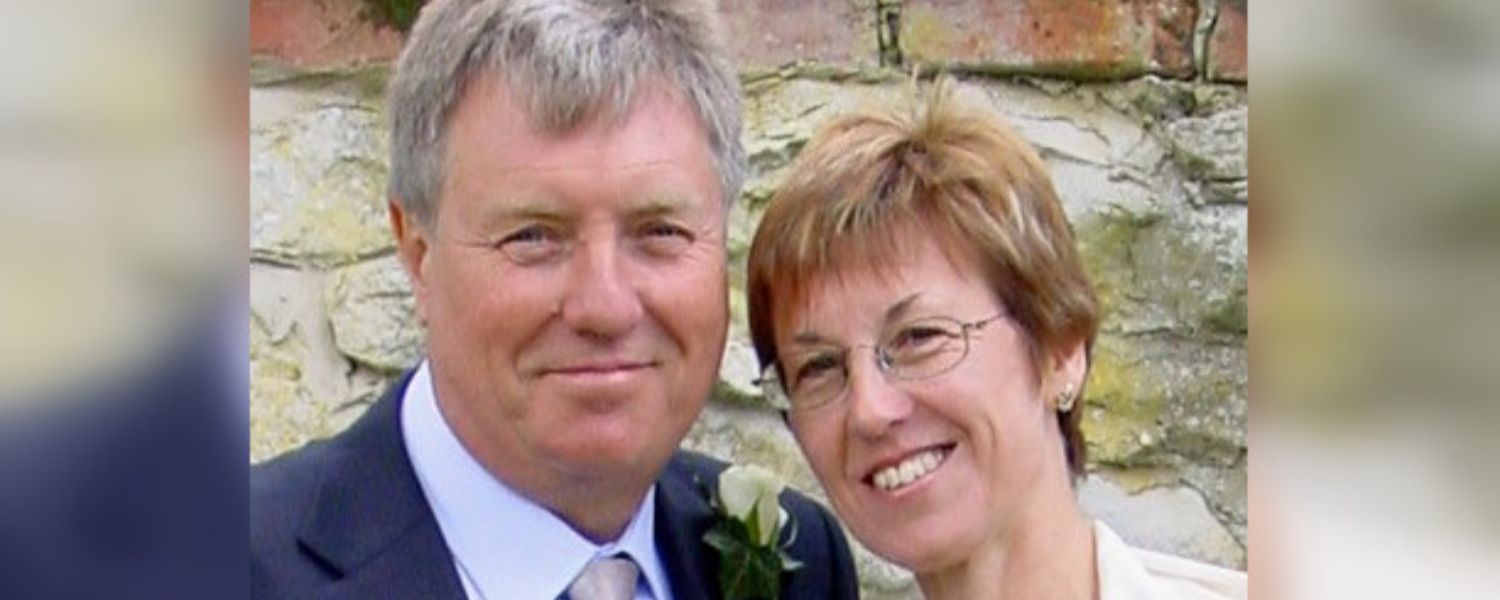
Sue’s husband, Philip, was diagnosed with prostate cancer in 2005 and died on Christmas Day 2009, aged 57. 16 years on, she reflects on the legacy he left behind.
It was a complete shock to us both when Philip was diagnosed with prostate cancer in 2005.
We had been together for 11 years.
Just before his diagnosis, in December 2004, we went away to South Africa. On Christmas Eve, while on holiday, we made the decision to get married sometime during the following year and had a celebratory dinner, just the two of us.
Before our trip, Philip had had a routine PSA test and we returned home to an email from the GP saying that his result was high. He was advised to have another PSA test – and this time, the result came back even higher.
So began the whole cycle that led to his diagnosis of prostate cancer at the age of 52.
Philip had surgery to remove his prostate, but before this went ahead, we rapidly organised our wedding for May 2005. Philip’s mantra in life had always been ‘What are you waiting for?’ We had already agreed that we would get married, so it made sense to get on and do it then. His words still ring in my ears today and they have helped me to get on with life since his death.
A year after having surgery the cancer came back. He had hormone treatment, followed by nine rounds of chemotherapy with the drug docetaxel. But after another couple of years the cancer became resistant to the treatment, and it spread. It went past his lymph nodes and reached his bones, and at this point, we thought we were out of options.
Philip’s quality of life at this time was generally very poor. He couldn’t leave the house much, and he certainly couldn’t play his beloved golf.
Philip loved golf. When he was having treatment, golf was one of the markers his oncologist used to see how he was doing. He’d always ask Philip if he’d played since he was last in, and if the answer was no, the oncologist would know he wasn’t doing well.
Philip’s oncologist told us about a clinical trial of abiraterone in patients where chemotherapy had failed. In January 2009, Philip was fortunate enough to be entered into the phase III trial, which was accepting patient volunteers in Oxford.
“I was staggered by the impact on his quality of life”
Within two weeks of starting the trial, Philip’s PSA had reduced significantly, but, more importantly, he was feeling much better. I was staggered by the impact abiraterone had on his quality of life. Philip was a really social person, but he’d found it so difficult to go out that he would often just stay at home, drained and exhausted.
I remember just a couple of weeks after Philip started abiraterone, I found him sitting at his laptop and asked what he was doing – he told me he was looking at flights to Cape Town. A friend of Philip’s from golf was going there with his wife, and they had a spare room.
.jpeg?sfvrsn=27373ab4_1 "Philip in South Africa in 2009 (Credit: Sue Duncombe)")
We went to South Africa in February 2009, in between clinical appointments. It was such a special trip. Philip got to play golf, and we got to see bits of the country we’d been to previously that had a special meaning for us, as of course, it was in South Africa that we had decided to get married just before Philip’s diagnosis. One of my favourite memories of the trip was spending time with Philip in Franschhoek, a small town outside Cape Town. It was a beautiful environment, and we had good food, good wine, the company of friends as well as each other. It was incredible, and it was unbelievable Philip was able to go when he’d recently been so unwell.
Our pioneering research is transforming the lives of men with prostate cancer. But too many lives are still lost. By supporting us today, you can help our scientists make more discoveries, develop more effective treatments – and give hope to every dad, brother, uncle, partner or friend with prostate cancer.
“Abiraterone gave us almost an extra year of quality time together”
We only went to South Africa for 10 days, because Philip had to get back for a hospital appointment, but we continued travelling over the next few months. We went to Provence in France, and we went on a flotilla holiday in the Mediterranean with our neighbours, where we taught them how to sail. It was a very active time, and it was such a contrast from when Philip was just sat at home, feeling tired, drained, and happy if people came to visit.
Abiraterone gave Philip the chance to live life to the full for eight whole months.
Sadly, the treatment eventually stopped working, and Philip died on Christmas Day 2009. In some ways, this seemed an apt date for someone with such a big personality. Philip was a very extrovert character and his death on Christmas Day almost felt like a statement – nobody could forget that date.
In the years immediately after his death, Christmas time was difficult. I had lots of friends and a supportive family, but it felt strange to suddenly be by myself. I was always invited to celebrate with people at their houses, but it felt to me as if I was joining other people’s Christmases. There was always a pressure to do something on Christmas Day, so in the end I decided to take control and for several years, I volunteered for the charity Crisis.
Philip always used to say that Christmas Day was ‘just another day’ and, in some ways, that made it easier for me to deal with the fact that it marked the anniversary of his death. I also had his ‘What are you waiting for?’ mantra in my head and this was a help too. I knew he was not coming back, but I was lucky enough to be in good health, financially secure and I had plenty of support from family and friends, so I could get on with life in a way that I hoped he would have wanted me to.
“Living with Philip taught me how to live without him”
Philip was a very positive person. I feel that living with him taught me how to live without him. Every Christmas, I post the same message on my social media pages, marking the number of years since his passing. Alongside a photo of Philip, I write, ‘I’m thankful for the memories. Thankful for the inspiration to live life to the full. Thankful for the motivation to improve cancer outcomes for cancer patients and their families.’
I am so proud of how taking abiraterone changed Philip’s life so positively and that by participating in the clinical trial, he has contributed to making a positive impact for other men and their families.
I feel so passionate about abiraterone – it gave us almost an extra year of quality time together, which we made the most of with family and friends. When a drug has such an impact on a patient’s life, it’s not just that person that benefits, but their family and friends too.
I’m really aware of the importance of research and how it can benefit individuals, and it is wonderful to think that Philip’s legacy is helping other men and their families get access to abiraterone.
I took up golf shortly after I married Philip, and it’s one of the best things I’ve ever done – I made a really good circle of friends in the golf club, and when Philip died, they were all there for me. Although I never got into it quite as much as my husband, I’ve played it ever since. I feel lucky I can exercise and travel and be active, fit and healthy. I want to live life – it’s there to be enjoyed.
We urgently need better ways to detect prostate cancer earlier, predict drug resistance, and develop smarter, more personalised treatments. Donate today to fund more groundbreaking discoveries and help ensure that every man with prostate cancer can live longer, healthier lives: