

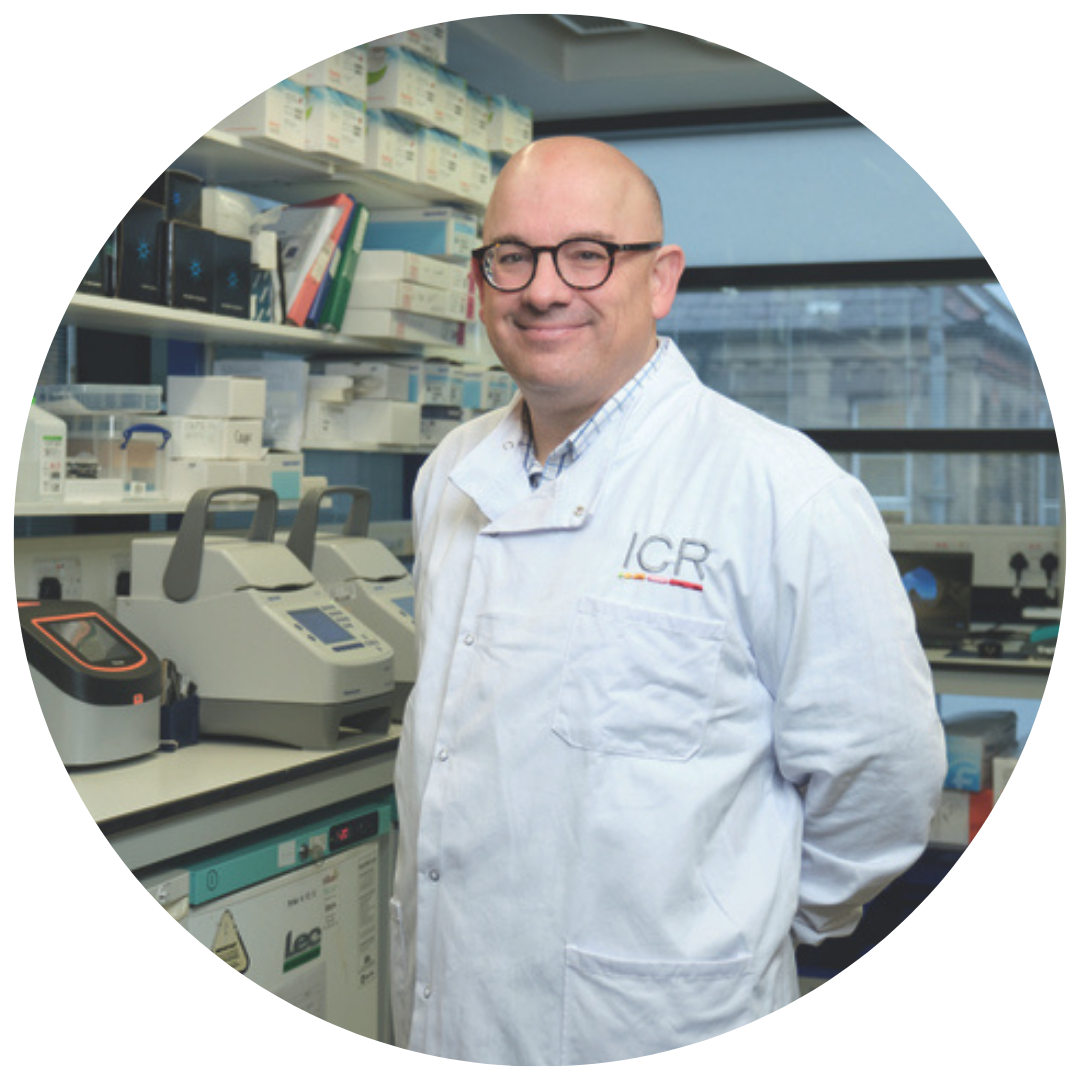
Richard Ware, 56, was diagnosed with stage 4 prostate cancer in 2022. Last December, he was told that it had spread to his brain. Following his diagnosis, Richard found out that he carries the BRCA2 gene mutation and for the past 10 months he has been treated with olaparib, the discovery and development of which was underpinned by research at the ICR.
My symptoms first started in 2021. I was getting up to wee more often in the night and I noticed that the flow of my urine was very slow. I went to my GP who diagnosed a urine infection, and I was sent home with antibiotics. But my symptoms continued for several months and after my fourth visit to the doctor, I was offered a physical prostate exam and a PSA (prostate-specific antigen) test which is used to help check for prostate conditions. My PSA test came back with slightly raised results but as the GP could feel nothing unusual during the physical exam, I was told there was no reason to be concerned.
However, I continued to go back and forth to the GP as my symptoms persisted. By January 2022, I was finding it harder to wee and it was stinging when I passed urine. I had never really heard of the prostate, but when my wife and I Googled my symptoms, I began to suspect that this could be the problem. Subsequent PSA tests showed my levels had gone up slightly, but they were never super high, which I have subsequently learned was quite unusual given how advanced my cancer was.
By April, I noticed that I was only ejaculating very tiny amounts of fluid. At this point, I was fast-tracked to see a urologist and an MRI scan clearly revealed I had prostate cancer. I had suspected this might be the case, but it was shocking to hear that it had already spread outside my prostate. A bone scan revealed that I had traces of cancer in my pelvis, although thankfully it had not spread to my soft tissue.
“The doctors told me it was incurable, but I was up for the fight”
Hearing you have stage 4 prostate cancer is tough. But I was determined to beat it and fight with everything I had. I was not going to let it change my life. The doctors told me it was incurable, but I was up for the fight. I believed in the developments of science and the treatments available to me – and I have stuck by this belief ever since.
I was put on hormone treatment immediately and had six doses of chemotherapy. When this finished towards the end of September 2022, I was told it had worked very well but I was offered a course of radiotherapy to follow up and give me the best chance of keeping the cancer away. In November 2023, I was told I was in remission. I remember getting off the phone feeling so relieved and happy. Sadly, I couldn’t fully celebrate my good health, as a few hours later I learned that my father had passed away.
In February 2024, I noticed a hazelnut-sized lump on my chest in the upper part of my sternum. It was growing very quickly, so much so that I struggled to do my top button up. Initially, my doctors were not concerned, believing that it was unrelated to my cancer. However, by the time it had grown to the size of a plum, I was referred to a neck specialist. A biopsy revealed that it was indeed cancer, but I was told it was unlikely to have spread from my prostate. Further scans showed there were lumps in the back of my neck and base of my spine too – although I couldn’t feel these at all.
I was immediately treated with an intense course of radiotherapy – daily treatments over a period of one or two weeks. To the surprise of my doctors, this totally dissolved the tumours, and I was given the all-clear a few weeks later. At this point, my oncologist gave me the nickname ‘Mr Unique.’ It was clear that not only did my cancer present itself in very unusual ways, but my responses to all the treatments were unusual too. I was told that my cancer was sensitive and fast-growing, but that it also reacted quickly and well to treatment. I was put on abiraterone, a drug which was discovered and developed by the ICR, and goserelin (Zoladex) hormone injections every four weeks.
Our pioneering research is transforming the lives of men with prostate cancer. But too many lives are still lost. By supporting us today, you can help our scientists make more discoveries, develop more effective treatments – and give hope to every dad, brother, uncle, partner or friend with prostate cancer.
“I put cancer to the back of my mind”
In June 2024, my daughter got married. It was an incredible day. After everything I had been through and with all the dancing I did that night, I was exhausted. But I looked well. I felt well. I put my cancer to the back of my mind and enjoyed every minute of the celebrations. I put my ill health behind me and booked a family holiday to Cornwall for 2025.
But in November, I started getting headaches. I had no other symptoms, and the headaches were not very severe. I assumed they could be a side-effect of the Zoladex but was told by my doctors that this was unlikely.
In December, I was changing jobs at work. I had never suffered with stress, but I started to get feelings of anxiety. Then I started slurring my words. I have never been a drinker or a smoker, but on several occasions, I was asked if I’d been drinking. I took myself to A&E, but after several hours of waiting in a corridor, I discharged myself and went home. I learned that if I slowed down my speech, I could stop the slurring, so I carried on as normal.
I’d always fancied a classic scooter, so after everything I had been through, I decided to treat myself to a 1960s Lambretta. I passed my licence that would allow me to drive it. Little did I know, I had taken the test with a brain tumour.
Then one day in December, I started being sick and again had a headache. My wife was not happy and called NHS 111 for medical advice. They organised an ambulance to take me to A&E immediately. My daughter came along with me. I was on the verge of being discharged with stress and anxiety, when she requested a CT scan on my brain. Two hours later, I was told I had a brain tumour the size of a ping-pong ball.
I had surgery the following day to successfully remove it. My slurring immediately stopped – in fact, I was singing fluently while in recovery! But before I was discharged from hospital, I had an MRI scan which revealed 16 micro tumours in my brain. These could not be removed with an operation, so I was treated with CyberKnife radiation therapy.
A biopsy on my original tumour revealed it had formed as a result of my prostate cancer spreading. I was told this is quite rare. It also revealed that tissue from my tumour tested positive for the BRCA2 gene mutation. As a result, I was put on the targeted treatment olaparib, which had been released to NHS prostate cancer patients just months before - and I have been on this ever since.
“There is no question that I am here because of cancer research”
Thankfully, my current treatment seems to be helping. Ten months on, my three-monthly scans have shown no new tumour growth. My medical team says it is remarkable. Even they did not expect this. My mum calls me ‘the bionic man.’ I am incredibly grateful for the support of my family and all three of my daughters throughout this journey.
It is so worrying waiting for the results of scans every few months – even when I feel well, it is scary to think what they might find. I have been beating this disease every time it rears its ugly head, but even though I am confident and upbeat and determined to win, I cannot help worrying about facing another setback.
In the meantime, I aim to live every day as normally as I can and I try not to worry until the day I am told there is nothing more they can do for me. My only frustration is not being allowed to drive, especially as someone who has worked in the motor trade all my life.
I am praying and hoping that scientists will come up with a new treatment when I next need it. I am very fortunate that two new drugs – abiraterone and olaparib – were available to me just when I needed them. I hope that something will be developed that will be able to stop this disease. What worries me most, is that scientists will manage to develop an incredible treatment, but that the cost of it will mean it won’t be made available to people who need it.
I’m still here despite everything and I am leading as normal a life as possible. I am back at work and looking forward to becoming a grandad for the first time early next year. Of course, I take the rough with the smooth and it has not been plain sailing. I deal every day with the side effects of my medications. But I am still on this planet and feel very blessed to be on the drugs I am.
I know I shouldn’t be here. But thanks to new medication and scientific advances, I am. There is no question that I am here because of cancer research. I would be dead without it. I have a good feeling about 2026 and I have a lot to live for. I cannot appreciate enough what cancer researchers are doing to help people to stay alive for longer. I cannot work out how I am in the position I am in – but I know that it is thanks to the amazing work being done by scientists who are making new discoveries every day.
We urgently need better ways to detect prostate cancer earlier, predict drug resistance, and develop smarter, more personalised treatments. Donate today to fund more groundbreaking discoveries and help ensure that every man with prostate cancer can live longer, healthier lives: