

Research led by The Institute of Cancer Research, London and King’s College London suggests that an early scan taken after one cycle of chemotherapy could help to predict how well a patient’s cancer will respond to treatment.
The study focused on patients with triple-negative breast cancer (TNBC), an aggressive form of the disease in which cancer cells lack receptors for the hormones oestrogen and progesterone, as well as the HER2 protein.
Patients with TNBC are usually treated with chemotherapy prior to surgery. While many respond well, residual disease at surgery - typically around six months later - is associated with a significantly poorer prognosis. Identifying people sooner who are unlikely to respond remains a major clinical challenge.
Scans after one treatment cycle indicate response
The research explored whether using PET imaging shortly after treatment begins - rather than relying only on MRI scans later in the treatment process - could provide earlier insight into how a patient’s cancer is responding. Twenty-two patients were recruited, with fourteen undergoing FDG-PET scans before treatment and after the first cycle of chemotherapy.
The findings, published in the journal Clinical Cancer Research, showed that changes seen on PET scans after just one cycle of chemotherapy were strongly associated with subsequent response, including whether there was no detectable cancer (known as a complete response)by the end of treatment. Importantly, early PET response showed stronger associations with treatment outcomes than standard mid-treatment MRI scans in this study.
Being able to identify patients who are not responding well at an early stage could allow clinicians to adjust treatment sooner or consider alternative approaches. These findings may also support future strategies to better tailor treatment intensity to individual patients.
Early biopsies showed similar results
The study also compared two types of PET tracers -FDG and FLT -to determine which was most suitable. While both met the study’s technical criteria, FDG-PET was selected for further evaluation due to its better image quality, greater consistency, and wider use in clinical practice.
The research also explored how imaging changes after just one cycle of chemotherapy relate to the body’s immune response to treatment. Biopsies taken before and after the first cycle of chemotherapy showed that an increase in immune cells within the tumour was strongly associated with both early PET changes and improved treatment outcomes.
The researchers emphasise that these findings now need to be validated in larger studies. Future work will aim to confirm these results in broader patient groups and explore more accessible imaging approaches, such as ultrasound, alongside PET and MRI.
‘The potential of early imaging to guide treatment decisions’
Professor Sheeba Irshad, Professor of Cancer Immunology at King’s College London (KCL) and lead of the Breast Cancer Now KCL Research Unit, said:
“In patients who had PET scans both before treatment and after the first cycle, we found that this early scan could predict whether they were likely to achieve a complete response by the end of treatment. These findings highlight the potential of early imaging to guide treatment decisions, and now need to be validated in larger, modern clinical trials.
Professor Andrew Tutt, Professor of Breast Oncology at The Institute of Cancer Research, London, said:
“Research that helps us determine early who is already benefitting from standard neoadjuvant chemotherapy and who might benefit from clinical trials to find better treatments is vital. This study shows that FDG-PET may have great value in this regard. We hope to be able to design studies that further investigate and validate these findings.”
The study was supported by funding from King’s College London and Guy’s and St Thomas’ NHS Foundation Trust, Breast Cancer Now, Cancer Research UK, and Guy’s and St Thomas’ Charity.
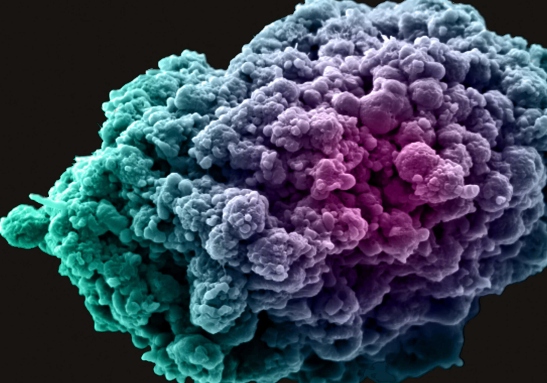
Image: A triple negative breast cancer cell. Credit: Melina Beykou, The Institute of Cancer Research.
