

Philanthropic gifts play a vital role in accelerating breakthroughs here at The Institute of Cancer Research, London – from kickstarting new research programmes and funding new laboratory equipment to supporting the next generation of scientists.
For two brothers, giving has been the fulfilment of a deeply personal responsibility. Peter and Steve Flowers became trustees of a Discretionary Will Trust left by Guy Seward, a friend of their father, who wished for parts of his estate to support a cancer research charity.
What followed was a journey that led them to select The Institute of Cancer Research (ICR) as the beneficiaries of the Trust, where his legacy is now propelling forward a pioneering drug discovery research programme, as well as funding cutting-edge technology, two PhD students and a Higher Scientific Officer.
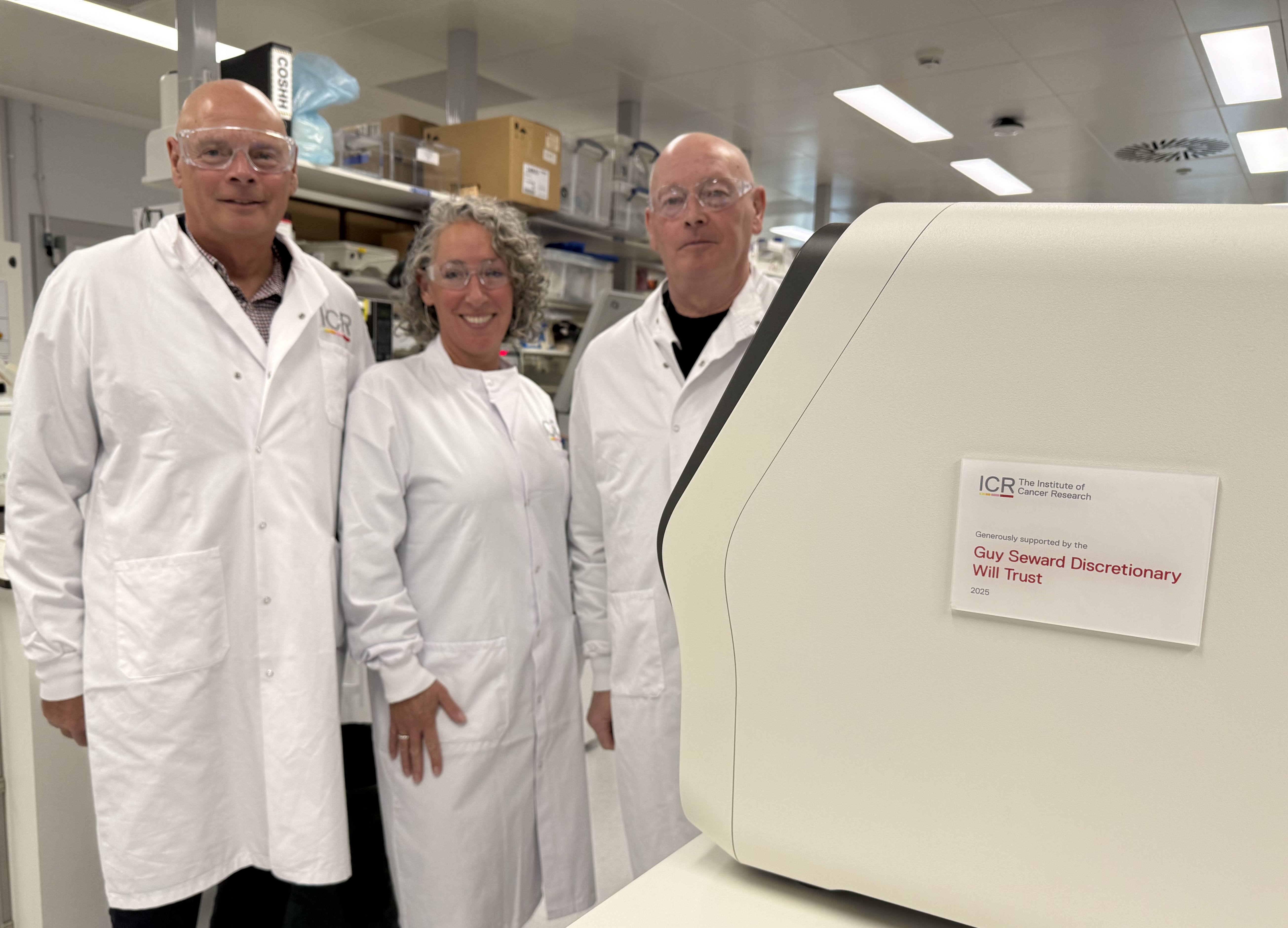
Image: Peter, Mel (Peter's wife) and Steve Flowers in the Centre for Cancer Drug Discovery
Fulfilling Guy’s legacy
After exploring different cancer research charities, Peter and Steve chose to support the ICR for our research legacy and the direct translation between donations and discoveries. Guy Seward’s gift was left in the form of shares – a specific legacy gift where designated stocks, investments or business shares are transferred to a registered charity as stated in an individual’s Will – providing a thoughtful way to turn personal assets into lasting impact.
The gift has been directed into funding two PhD students, new technology to streamline laboratory processes and an innovative research programme – nicknamed the Helicase project – in our Centre for Cancer Drug Discovery led by Dr Paul Clarke, Leader of the RNA Biology and Molecular Therapeutics Group in the Division of Cancer Therapeutics.
Peter Flowers said: “We wanted Guy’s legacy to fund not only a high-priority project for the ICR, but also several PhD students as we felt it was important to be funding the next generation of cancer researchers. The Helicase project seemed like a really good fit for this investment, and as neither of us have scientific backgrounds, we were invited to visit Dr Clarke to learn about the project in more detail and meet the numerous researchers in delivering it. We’re excited to follow its progress and are confident in the ICR’s ability to fulfil Guy’s legacy.”
Legacy gifts have underpinned our discoveries and achievements in cancer research throughout our history, leading to better diagnosis and treatments for patients. By leaving a gift to the ICR in your Will, you can help scientists continue their lifesaving research and offer hope to more people affected by cancer.
Making cancer cells more vulnerable
Since opening on our Sutton site in 2005, the Centre for Cancer Drug Discovery has discovered 21 drug candidates and taken 13 drugs into clinical trials, continuing to be one of the most successful academic drug discovery units in the world. One of the major pillars of its drug discovery programme is targeting a class of enzymes known as RNA helicases. These enzymes act as molecular motors in remodelling RNA – which carries instructions from DNA to produce proteins, the drivers of all cellular processes from metabolism, growth and immunity. RNA helicases are frequently overexpressed in cancers, driving tumour progression and contributing to the development of cancer.
Dr Clarke said: “These enzymes play a key role in how RNA functions, and cancer cells often rely on them to survive under stress. By targeting them, we hope to make cancer cells more vulnerable for drug targeting.”
“We’re incredibly grateful to Peter and Steve for their support. Their gift has allowed us to expand this project and think more broadly about targeting other types of RNA-binding proteins. While this work may not immediately lead to new drug discovery projects, gaining a deeper understanding of the underlying biology is a critical step toward identifying and validating future drug targets.”
Helena Dyke, whose PhD has been partly-funded by the gift, said: “As part of this project, I’m investigating how a particular class of RNA is processed in cancer cells when RNA helicases are targeted – analysing datasets to see which genes are affected and in the future will explore how these events determine whether cells grow or die. Thanks to this funding, I’ve been able to build new skills in computational biology and be part of the ICR’s wider research network – learning not just new techniques, but how they translate into patient benefit.”
The Guy Seward Discretionary Will Trust has also enabled the purchase of high-value, high-impact equipment designed to increase the speed and scale of experiments within the Centre of Cancer Drug Discovery and will be essential in delivering the Helicase project within the agreed timeframes.
Supporting the next generation of scientists
At the ICR, PhD students play a central role in progressing research forwards. Yet funding of these positions is highly competitive, and many talented scientists face uncertainty due to short-term contracts. Philanthropic funding provides not just opportunity, but stability, allowing research teams to focus on their work and build long-term careers, as well as creating a pipeline of new talent which will shape the future of drug discovery at the ICR and beyond.
In addition to supporting Helena Dyke, the gift from Guy Seward is also funding several other posts including Dr Caitlin Davies, Higher Scientific Officer in the RNA Biology and Molecular Therapeutics Group, and Uzma Khalid, a PhD student in the Evolution and Translational Genomics Group under Dr Ben O’Leary.
Uzma said: “This funding has made a significant contribution to my PhD into head and neck cancers caused by human papillomavirus (HPV) and in supporting me to become an independent researcher. My project aims to better understand why some HPV patients respond well to radiotherapy while others develop resistance, by looking at how treatment responses might be influenced by the ways in which the virus differs within the tumour. This is important because it could help us to identify which patients are more or less likely to benefit from treatment, allowing for more personalised approaches.”
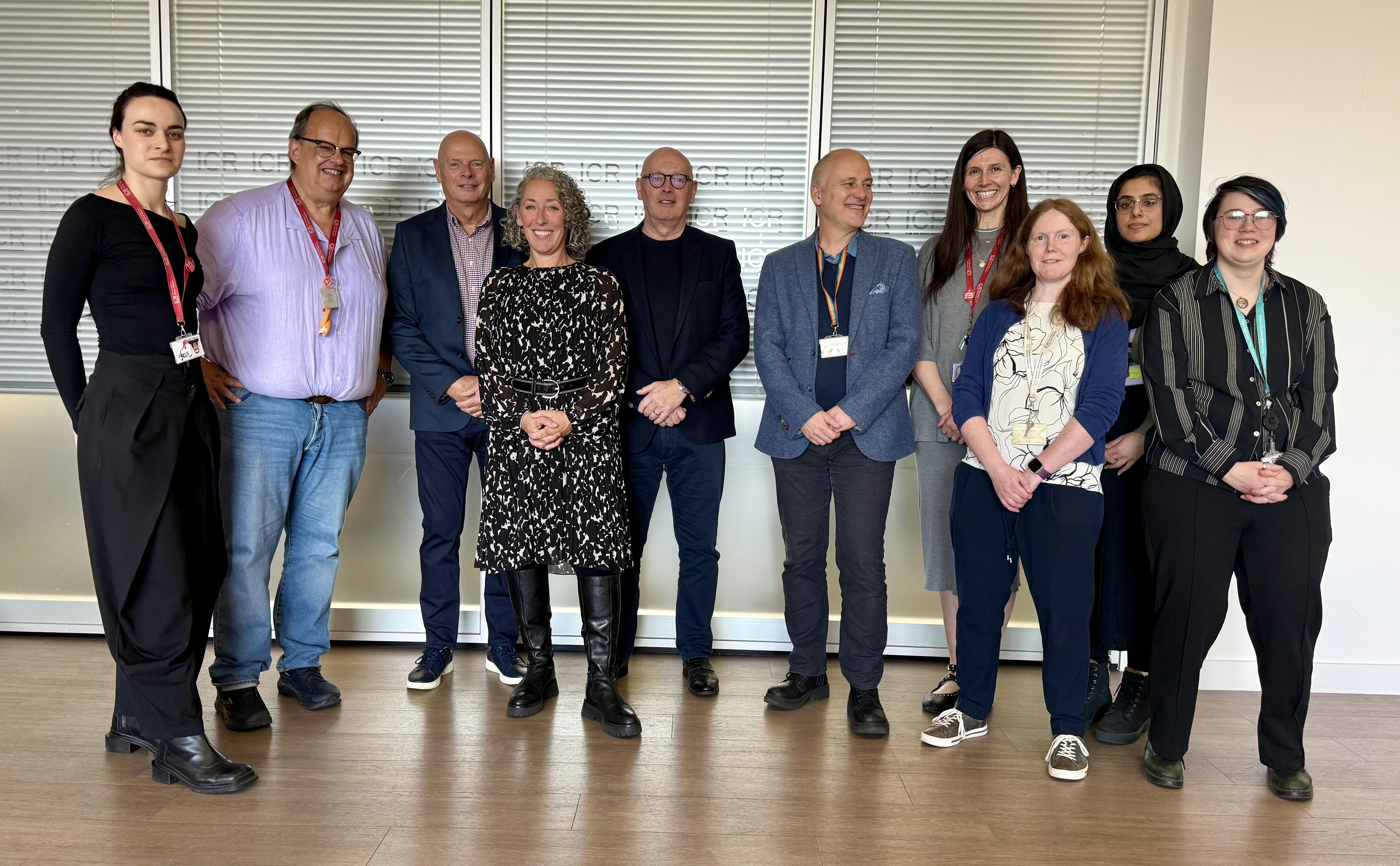
Image: Flowers family with the ICR team (L-R: Dr Caitlyn Davies, Dr Paul Clarke, Peter Flowers, Mel Flowers, Steve Flowers, Dr Rob Van Montfort, Dr Marissa Powers, Dr Caroline Ewens, Uzma Khalid and Helena Dyke).
A lasting legacy
For Peter and Steve Flowers, the impact of Guy Seward’s gift is measured not just in scientific progress, but in purpose. Guy Seward’s contribution will continue to have an impact for years to come – through the technology it has funded, the scientists it will support and the discoveries it will enable through the ongoing Helicase project.
Steve Flowers said: “Peter and I first heard about the ICR through our research into finding a suitable charity to fulfil Guy’s legacy, but we’re very glad they are the benefactors of Guy’s legacy. Sadly, cancer impacts a huge proportion of people, including both our parents and others we know who have died from the disease. It was great to have seen the new equipment already up-and-running in the labs and to have met Paul, Helena and Uzma, and the rest of the research team involved in the Helicase project.”
As a charity, we rely on the generosity and foresight of our supporters to sustain research like this into the future. Legacy gifts and philanthropic donations are vital to drive progress and ensure our work can make a difference to the lives of people with cancer. Together, we can deliver the next generation of breakthroughs – advancing new cancer treatments and bringing hope to patients. Find out here how you can make an impact with a philanthropic gift.